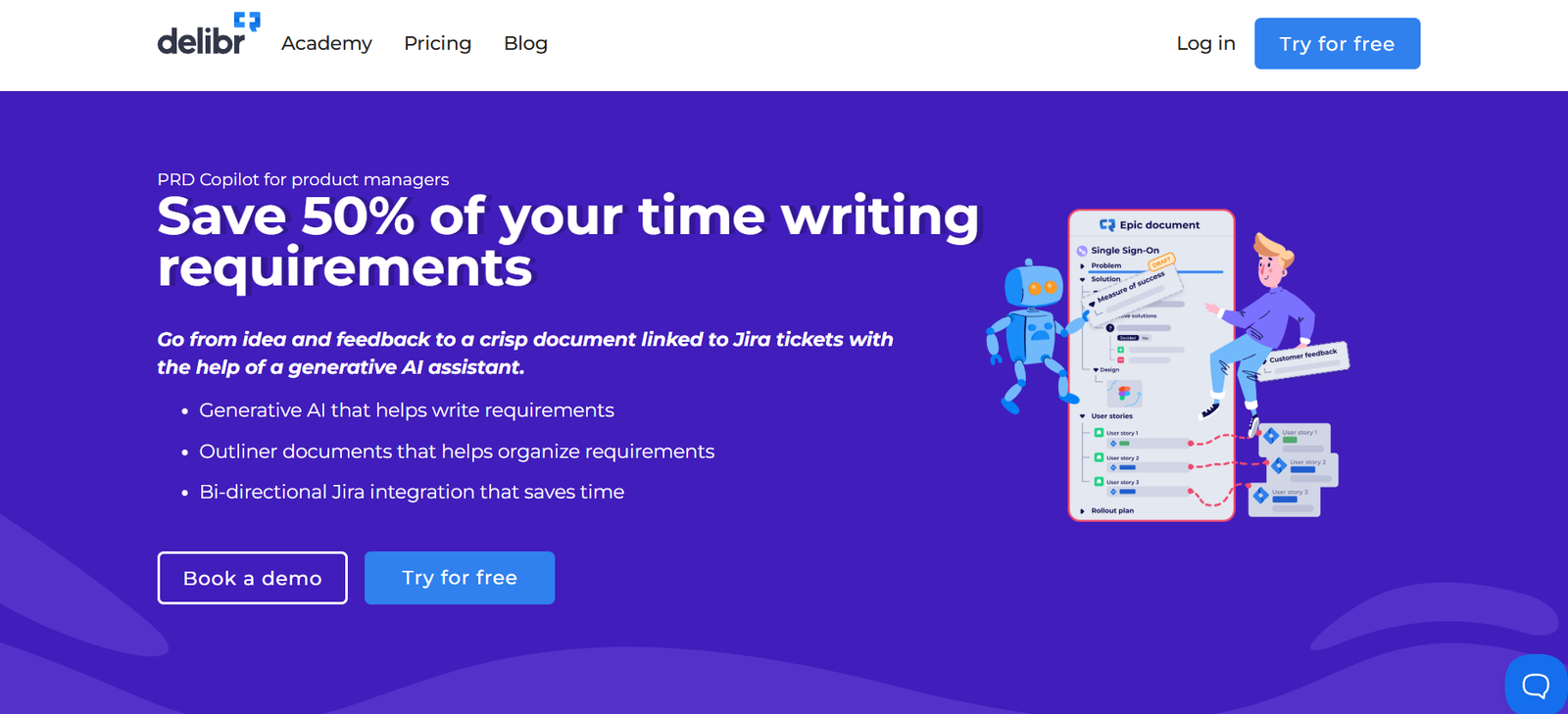
Delibr is a purpose-built product management platform designed to help product managers create, refine, and manage feature specifications collaboratively. It serves as a central workspace where teams can structure their thoughts, align on priorities, and produce clear, actionable documentation. Unlike general note-taking or project tools, Delibr is crafted specifically for the needs of product managers and cross-functional teams working in agile environments. It bridges the gap between idea, documentation, and development, ensuring that feature specs are refined, structured, and connected to product outcomes.
Delibr transforms how product teams operate by offering a rich, outliner-based editor that encourages structured thinking. The platform helps PMs write better product specs, link feature documents to strategy and OKRs, and collaborate with stakeholders to refine ideas before they reach the development phase. It integrates seamlessly with issue trackers like Jira and complements tools like Slack and Confluence, but focuses on the early, strategic stages of product work where clarity, alignment, and collaboration are essential.
Features
Delibr centers its value on its powerful outliner, which enables product managers to structure feature documents with precision. Unlike linear documents, the outliner encourages hierarchical thinking. Product specs are broken down into sections such as background, problem, goals, user stories, acceptance criteria, and questions. This format helps PMs think more clearly and allows teams to focus discussions around specific elements of the feature.
One of Delibr’s most useful capabilities is its ability to surface and manage open questions directly within documents. These questions are tracked until resolved, ensuring that nothing important gets lost during the feature refinement process. PMs can assign questions, tag team members, and reach consensus directly in the document.
Delibr also offers templates for common spec types, making it faster to get started. The tool allows for linking specs to strategy-level documents such as product goals or OKRs, helping PMs tie tactical work back to the big picture. Feature documents can be linked directly to Jira issues, ensuring a smooth transition from specification to implementation. As changes occur, the spec and the Jira issue can be kept in sync.
Another key feature is the ability to visualize the feature tree. This gives PMs a bird’s eye view of how various features relate to each other, supporting better prioritization and roadmap planning. The tool also offers inline comments and real-time collaboration features, allowing multiple stakeholders to provide feedback and contribute to feature specs simultaneously.
How It Works
Delibr is accessed via a web interface, where users can create and manage feature documents organized by product area or initiative. PMs start by outlining the structure of the spec using the built-in outliner. Each node of the outline can contain text, images, links, or embedded components. Team members can comment, suggest edits, and ask questions at any level of the document.
To facilitate decision-making, PMs can highlight questions, track their resolution, and loop in relevant stakeholders. Delibr provides visibility into which parts of the feature are still under discussion, making collaboration transparent and efficient. Once the spec reaches maturity, it can be pushed to Jira with a single click, turning user stories and acceptance criteria into ready-to-use Jira issues.
The document remains active even after handoff, enabling continued alignment during implementation. Because the tool is purpose-built for feature work, it supports a focused, distraction-free environment. The intuitive interface ensures that both technical and non-technical stakeholders can participate fully in refining product ideas.
Use Cases
Delibr is best suited for product teams that need to create well-defined, structured feature specs and ensure collaboration throughout the process. It is widely used by product managers who work in agile development environments and must maintain strong alignment between product, design, and engineering.
For early-stage startups, Delibr provides a scalable way to document evolving product ideas, ensuring clarity as the team grows. Mid-size and enterprise product teams benefit from the platform’s ability to manage feature refinement at scale, track open questions, and visualize product direction. Cross-functional teams that rely on clear specifications will find Delibr especially useful for bridging the gap between strategic thinking and development execution.
PMs who are frequently involved in cross-departmental planning, stakeholder alignment, or managing multiple feature initiatives simultaneously will appreciate the clarity and organization Delibr brings to their workflow. It can also serve as a knowledge base for past product decisions, reducing the need to constantly rehash historical context when discussing new iterations.
Pricing
Delibr offers multiple pricing tiers based on team size and functionality. The platform provides a 14-day free trial with full access to its core features, allowing product teams to explore the tool before committing. After the trial, pricing scales based on the number of users and required features.
While exact pricing is not displayed on the homepage, teams can request a quote or contact Delibr directly for custom pricing based on their needs. The platform is built to accommodate teams of all sizes, from small product teams to large enterprise organizations. A demo can be booked directly through the website for teams interested in a guided walkthrough of the tool and its features.
Strengths
Delibr’s main strength is its deep alignment with the product management workflow. It offers a focused environment for spec writing and decision-making that general-purpose tools cannot match. Its structured outliner format encourages thoughtful, hierarchical documentation and prevents messy, unstructured spec drafts.
The integration with Jira ensures that product development workflows remain cohesive from planning through execution. PMs can write, discuss, and finalize a spec in Delibr, then hand it off to engineering seamlessly. Real-time collaboration and question tracking enable faster decision-making and fewer missed details.
Delibr’s visual feature tree helps with strategic planning, allowing product leaders to understand how features fit into the broader roadmap. Templates and reusable content blocks improve consistency across specs, and linking to goals or OKRs ensures that every feature is tied to measurable business outcomes.
Another key advantage is the clarity it brings to cross-functional collaboration. By providing a single source of truth for each feature, Delibr reduces the back-and-forth communication that often slows down agile teams. It turns documentation into a living part of the product development process rather than a static deliverable.
Drawbacks
Delibr is a highly specialized tool, which means it may be less useful for teams looking for an all-in-one solution that includes roadmap visualization, sprint management, or analytics. It is not a project management tool and does not aim to replace Jira, Trello, or similar platforms. Teams that already rely heavily on a documentation platform like Confluence may experience some feature overlap, although Delibr’s structured spec writing is more refined.
New users may require a short learning curve to get used to the outliner interface, especially if they’re more familiar with traditional text editors. While the Jira integration is a major strength, teams not using Jira may not be able to take full advantage of Delibr’s automation capabilities. The platform also does not yet appear to have integrations with all major development tools, which could limit its use in diverse tech stacks.
Since pricing is not transparent on the site, some users may hesitate to commit without understanding the full cost. However, the 14-day free trial offers enough access for teams to evaluate the tool before making a decision.
Comparison with Other Tools
Delibr positions itself between note-taking platforms like Notion and issue trackers like Jira. Where Notion excels at flexibility and Jira at task management, Delibr carves out a space focused purely on feature refinement. It complements both platforms rather than competes with them. Compared to Confluence, Delibr offers more structure and better collaboration around feature questions and decisions.
Tools like Productboard or Aha! offer more in terms of roadmapping and prioritization frameworks, but they lack the detailed, structured spec writing capabilities Delibr provides. For teams that already have roadmap tools and want something focused purely on spec development and decision clarity, Delibr fills that gap effectively.
Customer Reviews and Testimonials
Delibr showcases positive feedback from real users on its homepage and through case studies. Product managers describe the tool as a game-changer for spec writing and team alignment. Users report that the outliner format helped them write clearer, more actionable specs and made collaboration with stakeholders far more efficient.
Several testimonials highlight the impact Delibr has on onboarding new PMs and developers, as all relevant context is documented in one place. Teams have seen fewer misunderstandings, faster decision-making, and smoother implementation after switching to Delibr. The tool is praised for reducing time spent in meetings and Slack threads by making all discussion points and decisions visible directly in the spec.
Conclusion
Delibr is a purpose-built solution for product managers who want to improve how they write, refine, and communicate feature specifications. It streamlines the process from idea to implementation by offering structured documentation, real-time collaboration, and integration with development tools like Jira. The platform’s outliner interface, question tracking, and visual feature trees help teams clarify goals, align stakeholders, and ship better features faster.
While it’s not a full project management suite, Delibr excels at what it is designed to do: help product teams think more clearly, communicate more effectively, and collaborate more confidently. For organizations that care deeply about building the right product with fewer missteps, Delibr is a tool worth considering.