
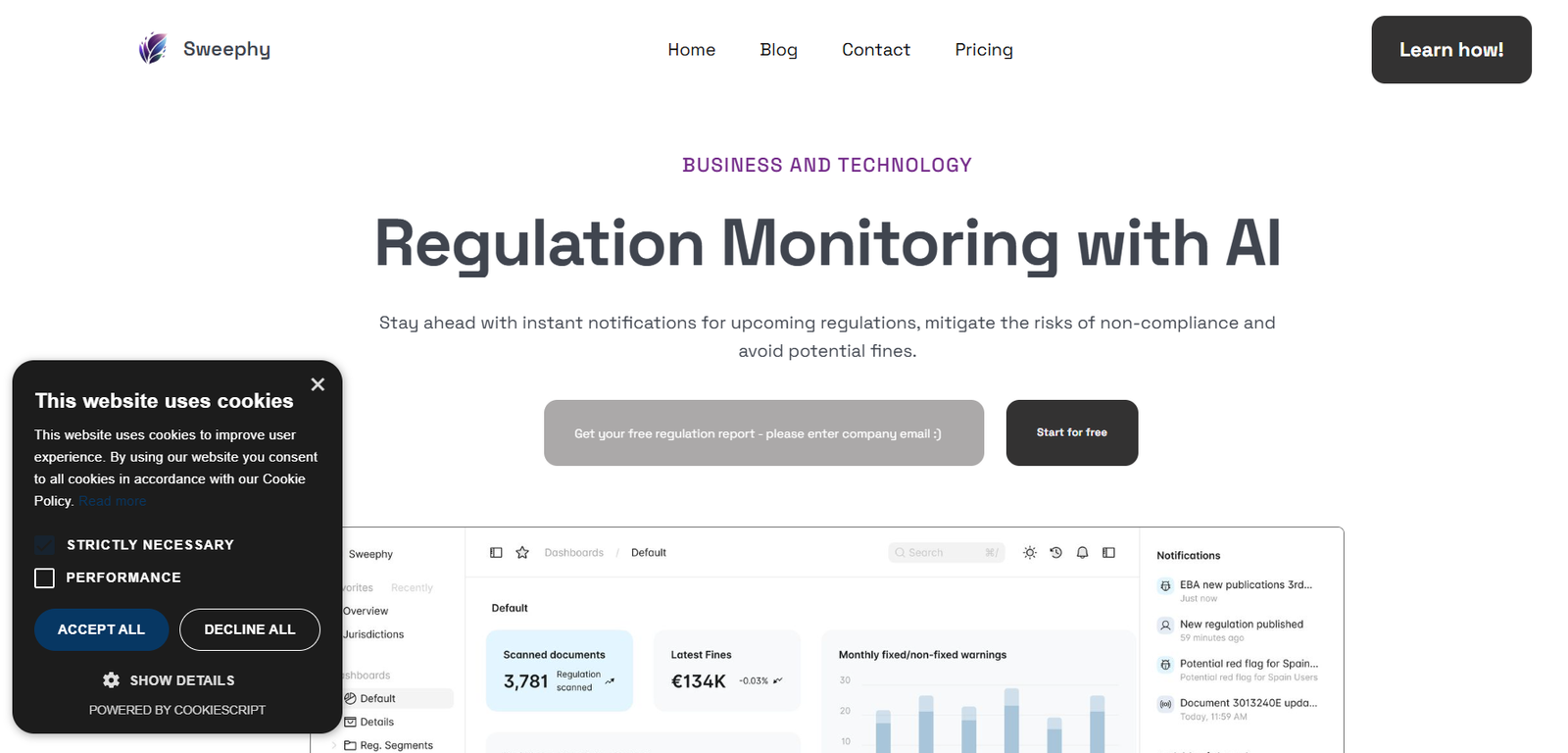
Sweephy AI is a no-code data cleaning and automation platform that empowers non-technical teams to clean, label, and analyze data efficiently. Designed to reduce the time and complexity involved in data preparation, Sweephy uses artificial intelligence to automate data-related tasks without requiring any programming knowledge.
Whether for customer feedback analysis, sales data structuring, or business intelligence, Sweephy enables users to organize, enrich, and validate datasets faster. It’s especially useful for teams in marketing, product, operations, and data who want to leverage data insights without waiting on engineering support.
By turning messy, unstructured data into clean, structured, and usable information, Sweephy helps businesses make faster, more informed decisions.
Features
Sweephy offers a wide range of features focused on AI-assisted data processing and no-code automation. One of its core features is automated data cleaning, which helps users fix typos, remove duplicates, detect outliers, and standardize formats without writing code.
Another key feature is data labeling, where users can classify and tag data for machine learning models, analytics, or business reporting. The AI suggests labels based on context, accelerating the labeling process while improving accuracy.
Data categorization allows users to group similar records using AI, which is especially useful for organizing customer feedback, survey responses, or support tickets.
Sentiment analysis is built into the platform, helping teams understand customer opinions, reviews, or social comments by analyzing emotional tone and scoring responses.
Sweephy also provides bulk editing tools that let users clean and update entire columns or datasets in just a few clicks. These tools help standardize entries like product names, departments, or customer segments.
The platform includes collaboration tools, enabling multiple users to work on the same datasets with controlled access and change tracking.
All of this is wrapped in a user-friendly, spreadsheet-style interface that feels familiar and intuitive for business users.
How It Works
Sweephy AI is built to make complex data tasks simple for non-technical users. To begin, users upload their datasets — typically in CSV, Excel, or JSON format — directly into the platform.
Once the data is uploaded, Sweephy analyzes the structure and highlights errors, inconsistencies, or missing fields. The platform then suggests automated cleaning actions using its AI engine, such as removing duplicates, correcting misspellings, and normalizing formats.
Users can also activate categorization and sentiment analysis tools to segment data or detect trends. The interface allows users to apply AI-suggested labels or create custom categories based on business logic.
When working with text data, Sweephy provides intelligent tagging and labeling options. For example, a company analyzing support tickets can label them by issue type or urgency, with AI helping to auto-suggest tags based on context.
The entire process happens inside a visual interface with point-and-click operations, eliminating the need for scripts or code. Once cleaned and processed, the dataset can be exported or integrated with external tools via API.
Use Cases
Sweephy AI supports a variety of use cases across industries. In marketing, teams use Sweephy to clean CRM data, categorize customer feedback, and perform sentiment analysis on product reviews or social media mentions.
For product teams, it’s useful for analyzing user feedback, support tickets, and usage logs to extract actionable insights about product performance or feature requests.
In customer service, Sweephy helps classify and prioritize incoming tickets, allowing teams to respond faster and more efficiently. AI categorization ensures each ticket is routed to the right department.
Sales teams use the platform to clean lead lists, merge duplicates, and enrich contact records with accurate data, which helps improve outreach and conversion rates.
Data analysts and business intelligence teams use Sweephy to preprocess large datasets before analysis or dashboard reporting, reducing the time spent on data wrangling.
Sweephy is also valuable in HR, where it helps analyze employee feedback, exit interview notes, or performance review comments to uncover trends in workplace sentiment.
Pricing
As of the latest information from the official Sweephy website, the platform offers a range of pricing plans tailored to different team sizes and usage needs:
Free Plan: Ideal for small teams or individuals starting with data cleaning. Includes access to basic features with limited rows and usage limits.
Pro Plan: Designed for professionals and small businesses. Includes extended access to AI tools, labeling features, and higher usage limits. Pricing is available upon request.
Business Plan: Built for larger teams with higher data volumes and collaboration needs. Includes API access, role-based permissions, and premium support. Custom pricing applies based on team size and data requirements.
Enterprise Plan: Tailored for organizations with advanced integration, compliance, and scale needs. Includes onboarding support, dedicated account management, and enterprise-grade features. Pricing is custom and provided after consultation.
Free trials and demos are available to help teams evaluate the platform before committing to a paid plan.
Strengths
Sweephy’s biggest strength is its no-code approach to complex data processing. It enables non-technical users to clean and structure data without relying on engineers or data scientists. This significantly reduces turnaround time for data projects and empowers business users.
The platform’s AI capabilities offer intelligent suggestions, which makes tasks like labeling, categorizing, and cleaning not only faster but also more accurate. It also helps minimize human error in manual data handling.
Its intuitive, spreadsheet-like interface lowers the learning curve, allowing teams to adopt the tool with minimal training. The ability to collaborate across teams and share datasets adds to its usability in multi-stakeholder environments.
The flexibility in pricing, including a free tier, makes it accessible for both startups and enterprise-level teams. The support for various file formats and integration via API also adds to its adaptability.
Drawbacks
While Sweephy excels in user-friendly data cleaning, it may not be suitable for users requiring advanced statistical modeling or machine learning beyond labeling and categorization. For those needs, more technical platforms like Python-based Jupyter notebooks or tools like Alteryx may be more appropriate.
The platform currently supports only structured and semi-structured data. Unstructured sources like images, audio, or complex web scraping may not be fully supported.
Users handling extremely large datasets may experience performance limitations unless they are on higher-tier plans with API access or cloud-based data processing.
Another limitation is the platform’s current language support. While English works well, multilingual NLP or sentiment analysis may not be as accurate in non-English languages, depending on the dataset.
Comparison with Other Tools
Compared to platforms like OpenRefine, Sweephy stands out with its AI-powered suggestions and no-code interface. OpenRefine is powerful but requires a steeper learning curve and is more suitable for technical users.
Versus Airtable or Google Sheets, Sweephy offers deeper automation for data cleaning, especially around AI-based classification and labeling. Those platforms are great for organizing data but lack smart suggestions and automation.
Against more enterprise-level tools like Alteryx or DataRobot, Sweephy offers simplicity and affordability, focusing on making data cleaning accessible to non-technical teams rather than advanced data science users.
For teams using Python scripts for data preparation, Sweephy can be a time-saving alternative, especially for tasks that don’t require complex coding or machine learning model training.
Customer Reviews and Testimonials
While third-party review platforms have limited data, the testimonials featured on the official Sweephy website highlight strong satisfaction among users across marketing, customer service, and product teams.
Users appreciate the ease of use and speed with which they can clean and prepare data. Many reviews emphasize how the platform helped reduce their dependency on engineering teams and shortened time to insights.
A common theme across testimonials is that Sweephy makes working with messy data more approachable for non-technical users. The ability to categorize, clean, and label data visually is especially appreciated by professionals in roles where fast decision-making is essential.
Conclusion
Sweephy AI is a powerful no-code data cleaning and automation tool designed to make data preparation faster, smarter, and more accessible. With its AI-assisted features, intuitive interface, and collaborative capabilities, it enables non-technical teams to extract value from raw data without writing a single line of code.
Whether you’re managing customer feedback, sales records, or internal reports, Sweephy helps ensure your data is clean, structured, and ready for action. Its flexibility, ease of use, and scalable pricing make it a practical choice for modern businesses of all sizes.


