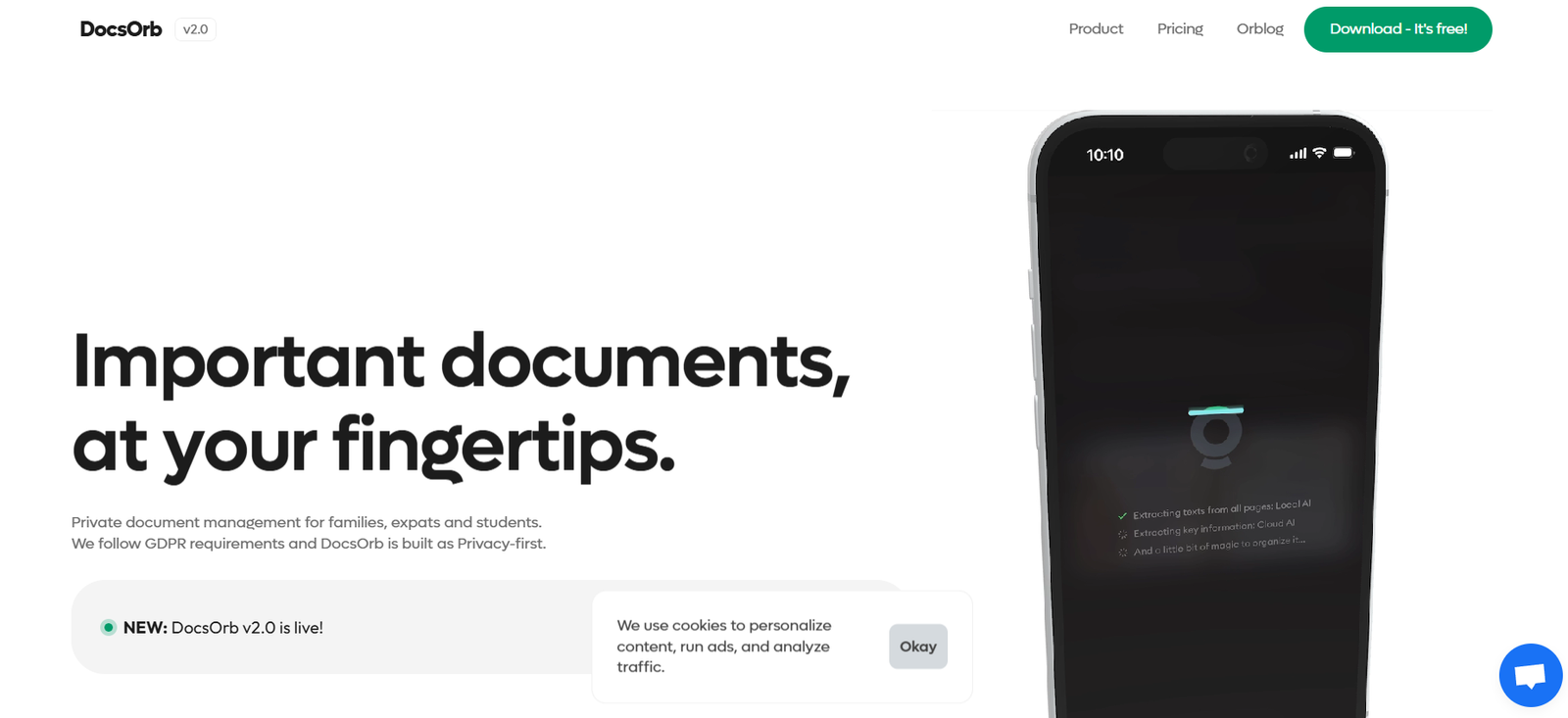
Docsorb is an AI-powered document workflow automation platform designed to help enterprises manage, process, and act on large volumes of documents with high accuracy and efficiency. It uses advanced machine learning and intelligent automation to extract data, validate content, route documents, and integrate with existing business systems.
Created to address the challenges of manual document handling, especially in data-heavy sectors like BFSI, healthcare, logistics, and manufacturing, Docsorb reduces processing times, eliminates errors, and improves compliance by ensuring every document is accounted for and processed systematically.
Docsorb combines cognitive data capture, intelligent document processing (IDP), business rule automation, and seamless integrations into one platform, making it a scalable and flexible solution for organizations looking to streamline back-office operations.
Features
Docsorb offers a wide array of features focused on automating the entire lifecycle of document processing.
The AI-powered document classification engine automatically detects the type of document—such as invoices, purchase orders, forms, or contracts—and initiates the appropriate workflow.
It includes intelligent OCR (Optical Character Recognition) to extract structured and unstructured data from scanned documents or digital files with high precision.
Docsorb supports business rule engines, which allow users to configure rules for data validation, approvals, or exception handling without writing code.
The workflow automation feature routes documents to the appropriate team or system based on content, priority, or other custom logic.
Integration capabilities are built-in, allowing seamless connectivity with ERP systems, CRMs, databases, and other enterprise software via APIs.
Docsorb includes audit trails and compliance checks, ensuring that all actions on documents are logged and aligned with regulatory standards.
The dashboard and analytics section provides real-time tracking of document flows, bottlenecks, and productivity metrics.
How It Works
Docsorb works by ingesting documents from multiple sources such as email, file uploads, shared drives, or cloud storage systems.
Once the documents are received, the AI model scans and classifies each file automatically. Then, the OCR engine extracts key data points from the content, such as names, dates, values, and other domain-specific fields.
Next, the system applies business rules to validate the data. For example, it may check whether the invoice total matches the PO or whether all mandatory fields are present.
Based on the validation outcome, the document is either approved, flagged for review, or routed to a specific department or external system.
All of this happens in real-time, and users can monitor workflows through a visual dashboard or receive notifications when manual intervention is required.
Use Cases
In the banking and financial sector, Docsorb is used to automate loan processing, KYC document verification, and account opening procedures.
Healthcare providers utilize Docsorb to manage patient records, insurance claims, and medical forms, reducing administrative burden.
In logistics and supply chain, the platform helps digitize and route shipping documents, delivery proofs, and customs forms, improving turnaround time.
Manufacturing companies implement Docsorb to automate invoice processing, vendor onboarding, and compliance reporting.
In insurance, the platform handles claims documents, policy paperwork, and customer submissions, speeding up the claims cycle.
Pricing
Docsorb follows a custom pricing model based on the volume of documents processed, the complexity of workflows, and the number of users or systems involved.
The official website does not list public pricing tiers, indicating that organizations must request a personalized demo and quote.
This approach suggests that Docsorb is primarily aimed at mid-size to large enterprises that require tailored configurations and integrations.
Strengths
Docsorb’s major strength lies in its ability to handle complex and high-volume document workflows using AI and automation.
The end-to-end automation significantly reduces the need for human intervention, resulting in faster processing and fewer errors.
Its no-code rule configuration allows business users to create and manage workflows without needing IT support.
Scalability is a strong point, as Docsorb can support a wide range of industries and use cases with varying levels of complexity.
The audit trails and compliance-friendly design ensure that organizations can meet regulatory standards without extra overhead.
Its flexible integration options allow seamless adoption into existing enterprise systems.
Drawbacks
One potential drawback is that Docsorb may require significant onboarding and implementation effort, especially for enterprises with legacy systems or highly custom workflows.
The lack of transparent pricing information may be a barrier for smaller organizations evaluating automation platforms.
There is currently limited availability of third-party reviews or customer testimonials, which may make it harder for new users to assess real-world performance.
The AI accuracy may depend on training and domain-specific tuning, which might require additional setup for certain industries.
Comparison with Other Tools
Compared to tools like UiPath Document Understanding or Automation Anywhere’s IDP, Docsorb provides a more unified and focused platform tailored for document workflows, without requiring extensive RPA knowledge.
While UiPath is heavily RPA-driven and may require more technical setup, Docsorb focuses on usability with pre-built AI models and no-code interfaces, making it more accessible to non-technical users.
Compared to Kofax or ABBYY FlexiCapture, Docsorb emphasizes integration and workflow automation more tightly, not just data extraction.
Unlike general-purpose document storage systems like SharePoint or Google Drive, Docsorb is built specifically for workflow automation, not just document management.
Customer Reviews and Testimonials
As of now, there are no verified customer reviews on third-party platforms like G2 or Capterra for Docsorb.
The official website shares case insights from industries like finance and logistics, highlighting improvements such as 70% reduction in processing time and near-zero error rates in document handling.
Clients reportedly value the flexibility of the platform, especially its ability to adapt to changing business rules and documentation formats.
Additional published case studies or testimonials would further support credibility and help new customers evaluate performance.
Conclusion
Docsorb is a robust AI-based solution for automating enterprise document workflows. Its strengths lie in accurate data extraction, intelligent routing, and seamless integration with business systems.
Designed for data-heavy industries, it reduces manual labor, improves compliance, and accelerates turnaround times. The platform’s no-code rule engine and AI automation make it accessible to business users, not just IT teams.
While it may require some onboarding effort and lacks public pricing transparency, Docsorb remains a strong contender for enterprises seeking to modernize their document processing systems.
Organizations looking to improve operational efficiency through AI and automation should consider scheduling a demo to explore Docsorb’s capabilities in depth.