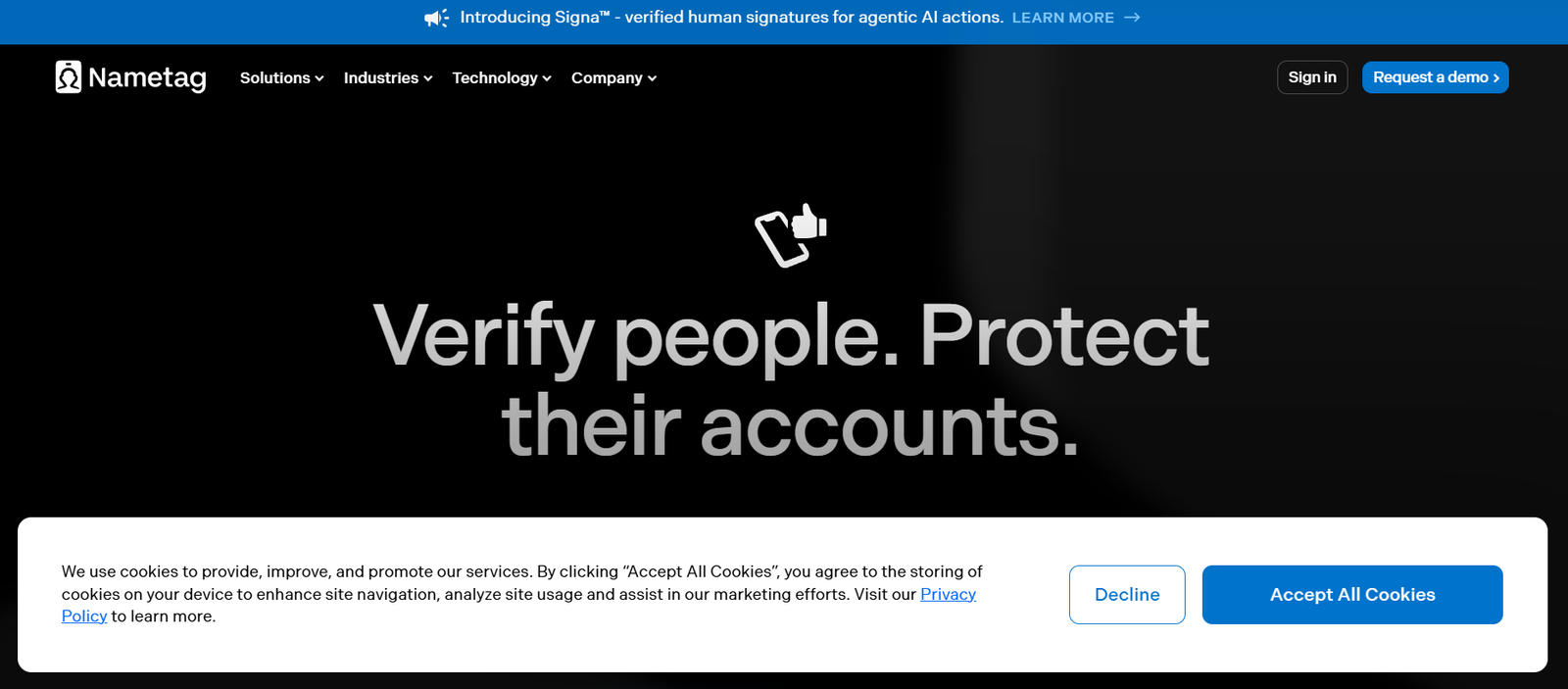
Nametag is an identity verification platform that enables secure, passwordless authentication using AI and biometrics. Designed for businesses that prioritize security and user trust, Nametag helps eliminate the need for passwords, security questions, and manual ID checks. With just a face scan and government ID, users can confirm their identity in seconds.
Nametag combines advanced facial recognition, AI-driven fraud detection, and document verification to protect against impersonation, phishing, and account takeovers. Its mission is to make proving who you are online as easy and safe as unlocking your phone.
By integrating directly into websites, apps, and support systems, Nametag empowers organizations to authenticate customers and employees without friction—turning identity verification into a seamless, secure experience.
Features
Nametag offers several advanced features that modernize identity verification and authentication. The platform’s core feature is Sign in with ID, which allows users to securely log in to services by scanning a government-issued ID and verifying their face. This approach replaces passwords with a secure, biometric-based login experience.
Nametag also includes Smart Links, enabling organizations to send users personalized, secure login links via email or SMS that begin the ID verification process with a single tap. The system supports multi-platform usage, working across web, mobile, and enterprise environments.
For customer support teams, Nametag offers Support by Nametag, which lets agents verify user identity directly during support interactions—without asking personal questions or requiring users to submit screenshots of their ID. This increases both speed and security in high-risk support workflows.
Security features include real-time fraud detection, anti-spoofing, and tamper detection. All data is encrypted in transit and at rest, and the platform adheres to modern data protection standards.
How It Works
Using Nametag begins with integrating it into your app or website. Businesses can embed Nametag’s authentication flows into their login pages, customer portals, or support platforms. Once configured, users can start the verification process with a simple link or button click.
The user is prompted to scan their government-issued ID using their phone camera. Nametag then captures a facial image and compares it against the ID using facial recognition AI. This real-time comparison verifies that the user is who they claim to be.
Once verified, users are issued a secure digital credential that allows them to log in instantly next time without repeating the full process. For customer support, agents can send a Smart Link to initiate verification within a live chat or support ticket, ensuring only the rightful account owner can proceed.
Nametag handles all the backend processing, including image validation, fraud screening, and compliance. The result is a seamless identity verification experience that replaces knowledge-based authentication with secure, biometric assurance.
Use Cases
Nametag serves multiple industries and use cases. In financial services, it is used to prevent account takeover, authenticate high-value transactions, and streamline KYC processes. For healthcare providers, Nametag offers secure patient login to medical portals without the need for usernames or passwords.
E-commerce and retail platforms use Nametag to verify customers before account recovery or major purchases, reducing fraud and improving customer trust. Technology and SaaS companies use it for passwordless employee login, customer onboarding, and support identity verification.
Customer support teams benefit from Nametag’s ability to verify users instantly during support interactions, eliminating the need to ask security questions or rely on screenshots. Education platforms also use Nametag to verify student identities during remote assessments or account access.
Pricing
Nametag does not publicly display its pricing structure on the official website. Instead, it offers customized plans based on business needs, volume of verifications, and integration requirements.
Organizations can request a personalized demo and pricing by contacting the Nametag sales team. This suggests a flexible, scalable pricing model suitable for companies of different sizes—from startups to large enterprises—with tailored support and deployment options.
While the lack of public pricing may not suit small teams looking for upfront transparency, the personalized approach ensures that businesses receive a solution aligned with their security needs and usage volume.
Strengths
Nametag’s biggest strength is its ability to eliminate passwords while enhancing security. By combining facial recognition, ID verification, and AI fraud detection, the platform offers strong protection against impersonation, phishing, and social engineering attacks.
The platform is user-friendly and does not require users to download an app. Verification can be completed directly through a browser on any device. This accessibility increases adoption and reduces friction.
Nametag also excels in compliance and privacy. It is designed with data protection in mind, using encryption and offering consent-based access to user information. For businesses in regulated industries, this focus on secure identity handling is a major advantage.
Another strength is Nametag’s deep integration options. Whether for login, support verification, or access control, the platform fits seamlessly into existing workflows through SDKs and APIs.
Drawbacks
One drawback is the absence of self-serve pricing, which may deter smaller businesses or startups from evaluating the product without engaging with sales.
Another limitation is that Nametag’s functionality is heavily focused on identity verification and passwordless login, which may not meet broader authentication needs such as multi-factor authentication without ID.
Also, while Nametag is powerful for users with access to a smartphone and government-issued ID, its use may be limited in contexts where users cannot provide these. This may exclude certain user segments depending on the use case.
Comparison with Other Tools
Compared to tools like Okta, Auth0, or Duo Security, Nametag provides a more identity-centric, biometric authentication method rather than traditional password-based or device-based MFA.
Unlike LoginRadius or OneLogin, which focus on user management and authentication layers, Nametag emphasizes secure identity verification through government ID and facial recognition. This makes it particularly useful for high-risk access points and regulated workflows.
Nametag also competes with identity verification tools like Jumio or Onfido, which provide ID verification but are typically used in onboarding scenarios rather than as part of ongoing login or support processes. Nametag uniquely positions itself at the intersection of login and ID verification, bringing real-time assurance to user authentication.
Customer Reviews and Testimonials
As of now, Nametag’s official website does not feature detailed customer reviews or testimonials. However, it includes endorsements from industry experts and promotes partnerships with cybersecurity-focused organizations.
The platform appears to be used by security-conscious teams across finance, healthcare, tech, and retail. Businesses interested in seeing the product in action are encouraged to book a demo and request case studies.
Given its enterprise positioning, feedback and case studies may be shared privately with prospective customers during the sales process.
Conclusion
Nametag is a next-generation identity verification and authentication platform built for a world where passwords are no longer secure. By combining biometric face recognition with real-time ID validation, Nametag offers a highly secure and frictionless alternative to traditional login methods.
Its strengths lie in simplicity, privacy, and seamless integration across login, support, and user verification workflows. While it may not be ideal for small teams looking for self-service onboarding or for users without valid ID access, Nametag is a top choice for businesses seeking to improve security while enhancing user experience.
For companies operating in regulated industries or facing increasing security threats, Nametag provides a powerful way to know exactly who’s on the other side of the screen—safely, quickly, and without passwords.