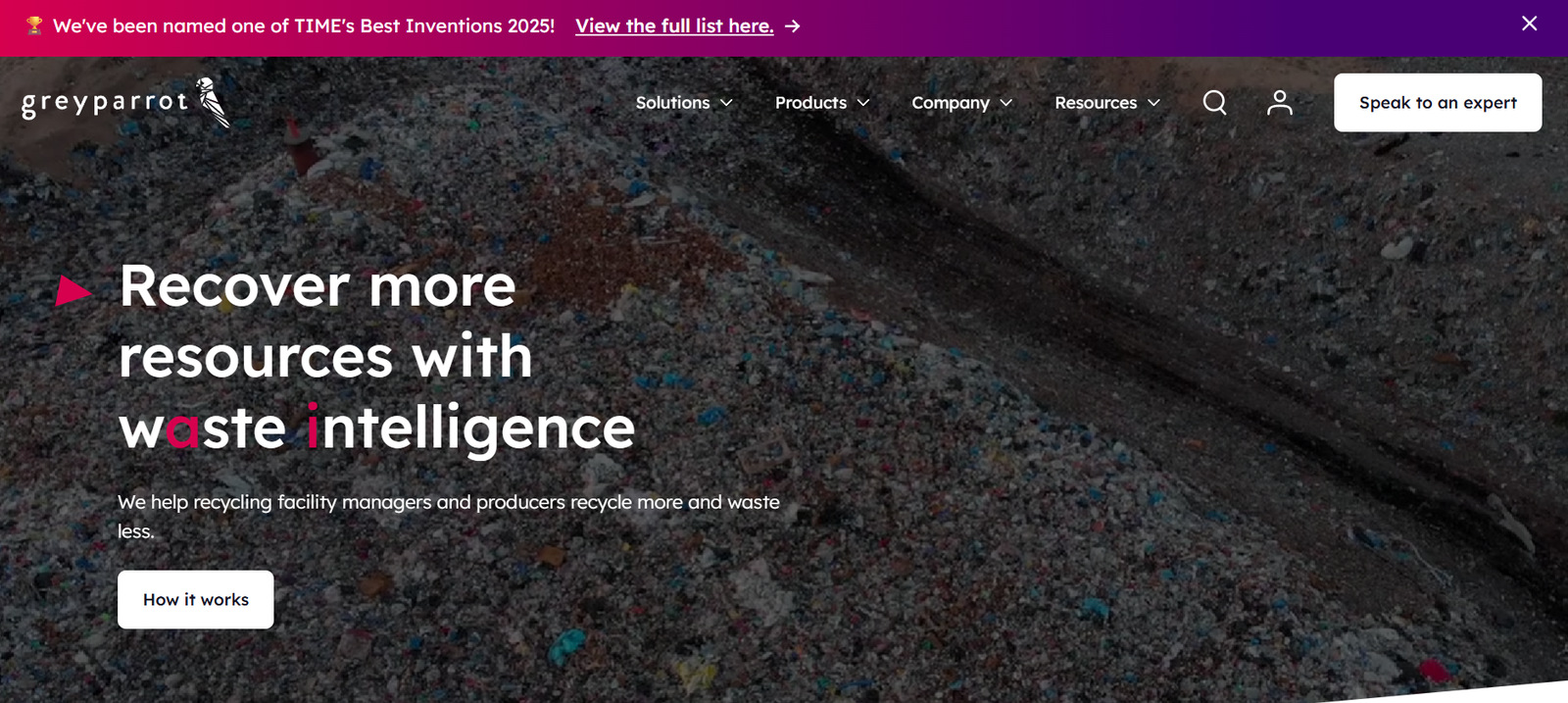
Greyparrot AI is an innovative environmental technology company using artificial intelligence and computer vision to revolutionize the waste management and recycling industry. Founded in the United Kingdom, the company’s mission is to drive transparency, automation, and efficiency within the global waste value chain, enabling a smarter and more sustainable circular economy.
The Greyparrot AI system identifies, tracks, and analyses waste in real time. It automates manual sorting processes and provides valuable data insights to recyclers, waste managers, and policymakers. By deploying AI-powered cameras and data analytics in recycling facilities, Greyparrot helps organizations understand the composition of their waste streams, improve recycling rates, and reduce landfill dependency.
In an era where sustainability and resource management are global priorities, Greyparrot AI stands out as a transformative solution, bridging the gap between technology and environmental responsibility.
Features
Greyparrot AI offers an advanced suite of features that bring automation, precision, and data intelligence to waste management operations.
At its core is the AI Waste Recognition System, which uses deep learning algorithms and computer vision to identify and classify waste items moving along conveyor belts in recycling plants. The system recognizes a wide range of materials, including plastics, paper, metals, and glass, with high accuracy.
The Waste Intelligence Platform aggregates data from AI-powered cameras installed in material recovery facilities (MRFs). It provides real-time insights into waste composition, contamination levels, and recycling performance.
Greyparrot AI also includes customizable dashboards and analytics tools, allowing operators to visualize data trends, track performance indicators, and make data-driven operational decisions. This enables recycling plants to monitor efficiency, detect bottlenecks, and enhance recovery rates.
Another significant feature is API integration, which allows seamless connection with existing waste management software and operational systems. This ensures that insights from Greyparrot AI can easily be incorporated into larger facility management processes.
The system’s machine learning capabilities enable continuous improvement. As the AI analyzes more data, it refines its classification accuracy and adapts to new waste types or packaging materials.
In addition, Greyparrot offers automated reporting that helps stakeholders comply with regulatory requirements, sustainability goals, and environmental reporting standards.
How It Works
Greyparrot AI operates through an intelligent combination of computer vision, deep learning, and cloud-based data processing.
The process begins when AI-powered camera units are installed along conveyor belts in recycling facilities or waste sorting centers. These cameras capture high-resolution images of materials passing through the line.
The images are processed by the Greyparrot AI system, which uses neural networks trained on millions of waste images to identify and classify each item. The AI can recognize different types of packaging, brands, and materials in real time.
Once classified, the system aggregates this data and sends it to the Waste Intelligence Platform, where it is analyzed and visualized through dashboards. Facility managers can then use this data to assess contamination rates, optimize sorting efficiency, and measure recovery performance.
The continuous feedback loop allows the AI to learn and adapt. When new types of packaging enter the waste stream, Greyparrot’s algorithms can quickly adjust, ensuring the system remains accurate and relevant in a fast-evolving waste landscape.
This data is also valuable beyond facility operations—it can be shared with manufacturers, brands, and policymakers to support sustainability reporting, extended producer responsibility (EPR) compliance, and circular economy initiatives.
Use Cases
Greyparrot AI has numerous applications across the waste management and recycling ecosystem.
In recycling facilities, it provides real-time visibility into waste composition, helping operators optimize sorting performance and improve material recovery rates. The insights also assist in identifying contamination sources and ensuring compliance with environmental regulations.
Municipal waste authorities use Greyparrot AI to gather accurate data on local waste generation and recycling performance. This information supports policy development, sustainability targets, and waste reduction strategies.
For packaging manufacturers and consumer brands, Greyparrot AI offers valuable data on how their products and materials perform in the recycling stream. This helps companies design more recyclable packaging and meet sustainability goals.
Waste management companies leverage Greyparrot’s analytics to streamline operations, improve plant throughput, and reduce reliance on manual labor for waste inspection.
In environmental research and policy, the data generated by Greyparrot AI provides unprecedented transparency into global waste flows, helping governments and NGOs track progress toward circular economy objectives.
Pricing
Greyparrot AI provides flexible pricing models based on deployment size, number of camera units, and analytical features required.
Pricing is typically structured as a combination of hardware installation costs and subscription-based software access. The subscription covers data processing, AI model updates, analytics dashboards, and technical support.
Enterprise and municipal customers can request custom solutions, which may include advanced analytics modules, API integrations, or multi-site deployments.
For detailed pricing information, organizations can contact Greyparrot directly through their official website greyparrot.ai, where demos and consultations are also available.
Strengths
Greyparrot AI’s main strength lies in its unique combination of AI-driven automation and environmental impact. By turning visual data into actionable intelligence, the platform provides measurable results for both operational efficiency and sustainability.
Its real-time waste composition analysis gives unprecedented visibility into recycling processes that were previously opaque and labor-intensive. The system’s accuracy and adaptability make it reliable in dynamic environments where waste types constantly evolve.
The platform’s data-driven approach allows waste operators and policymakers to base decisions on facts rather than estimates. This transparency drives accountability across the entire waste value chain, promoting a more sustainable circular economy.
Greyparrot’s technology also helps address one of the industry’s biggest challenges: contamination. By detecting impurities early, it enables facilities to maintain higher-quality output and reduce rejected materials.
Another major strength is scalability. The modular camera setup and cloud infrastructure make it easy to deploy across facilities of varying sizes and capacities.
Moreover, the company’s commitment to environmental sustainability enhances its reputation as a purpose-driven innovator, aligning technology with global environmental goals.
Drawbacks
Despite its advantages, Greyparrot AI may present some challenges. The initial installation of AI camera systems requires an upfront investment, which may be a consideration for smaller facilities or municipalities with limited budgets.
System performance depends on factors such as lighting, conveyor speed, and camera placement, requiring careful setup for optimal results. While the AI continuously improves, occasional misclassifications can occur, particularly when dealing with damaged or heavily contaminated waste items.
The platform’s advanced analytics tools may also require brief training for teams unfamiliar with data visualization or AI technology.
However, these challenges are common in any high-tech industrial deployment and are outweighed by the operational and environmental benefits the system delivers.
Comparison with Other Tools
When compared to other waste management technologies, Greyparrot AI stands out for its exclusive focus on AI-based waste recognition and data intelligence.
Traditional mechanical sorting systems rely heavily on manual labor or physical sensors to separate materials, whereas Greyparrot uses visual intelligence to enhance accuracy and efficiency without major infrastructure changes.
Compared to industrial robotics companies such as AMP Robotics or ZenRobotics, Greyparrot differentiates itself by focusing on data analytics and transparency rather than automation alone. It acts as the “brain” of the waste management process, enabling smarter decisions across the entire value chain.
The platform’s data-centric approach also benefits manufacturers and policymakers, extending its utility beyond operational optimization to environmental reporting and circular economy tracking.
Customer Reviews and Testimonials
Greyparrot AI has received widespread recognition from environmental organizations, recycling operators, and sustainability leaders for its impact on waste management efficiency and transparency.
Recycling facility managers commend the system’s ability to provide real-time data that was previously unavailable, helping them identify inefficiencies and improve output quality.
Corporate clients and packaging producers highlight how Greyparrot’s insights have helped them redesign packaging for better recyclability and sustainability performance.
Industry experts praise Greyparrot’s contribution to bridging the gap between technology and environmental stewardship, noting its pivotal role in advancing circular economy initiatives.
While some users suggest adding more regional customization options for waste classification, the consensus remains overwhelmingly positive regarding accuracy, usability, and environmental value.
Conclusion
Greyparrot AI represents a major leap forward in how humanity manages waste, combining artificial intelligence and computer vision to bring visibility, accountability, and efficiency to recycling operations.
By automating waste analysis and providing real-time data intelligence, Greyparrot enables facilities, brands, and governments to make informed decisions that directly contribute to sustainability goals. It transforms waste from an overlooked byproduct into a measurable, manageable, and valuable data resource.
In a world striving toward a circular economy, Greyparrot AI is not just a technological innovation—it is a catalyst for systemic environmental change.