
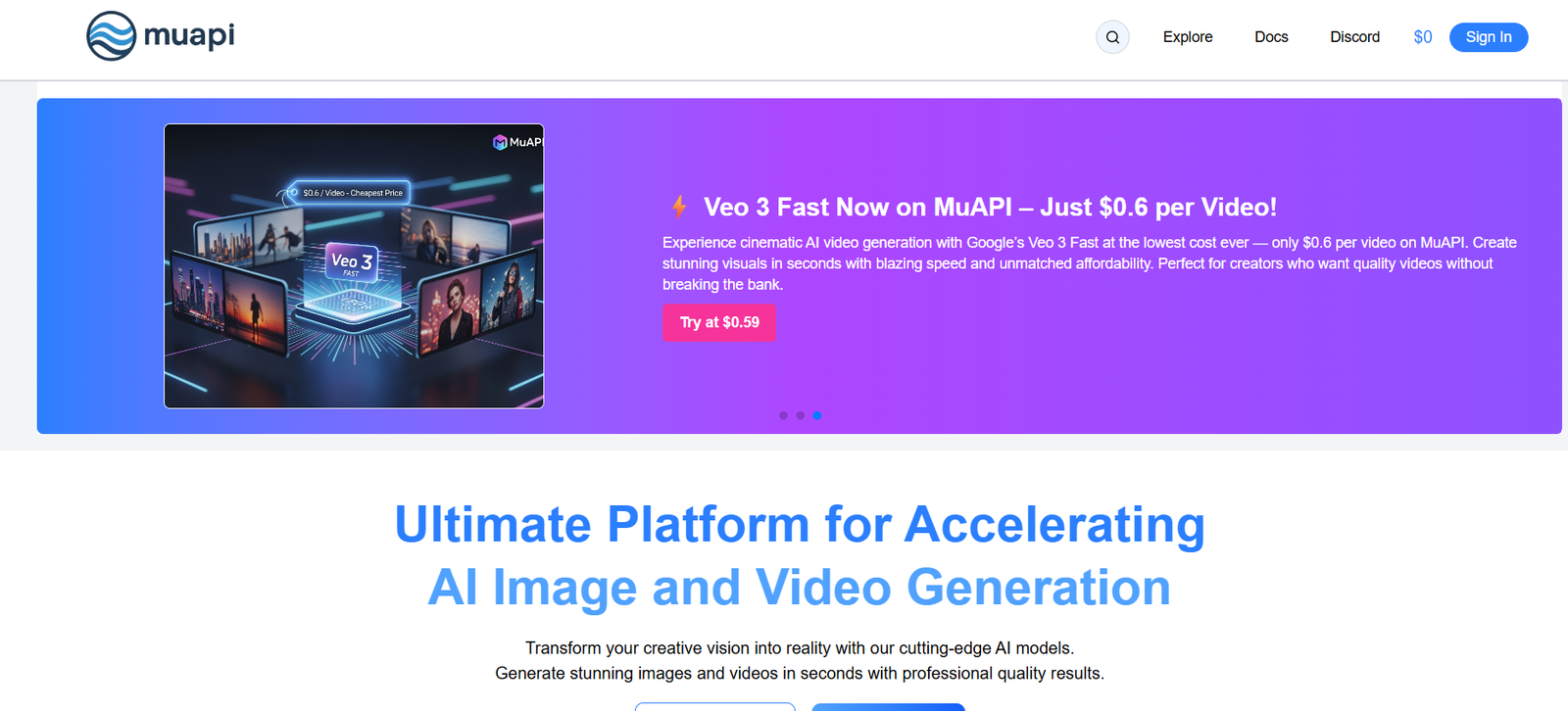
MuAPI is a unified API platform that allows developers to integrate multiple AI models from different providers using a single interface. It simplifies the process of working with large language models (LLMs), image generation tools, and other generative AI services by offering one consistent and developer-friendly API. Instead of managing multiple keys, SDKs, or endpoints, developers can use MuAPI to access leading AI providers such as OpenAI, Anthropic, Mistral, and more—all through one gateway.
MuAPI is built for developers, startups, and enterprises looking to build AI-powered applications faster and more reliably. It reduces integration complexity, improves flexibility in model selection, and provides tools like prompt management, usage tracking, and cost control—all within a single platform.
Features
MuAPI offers a wide range of features that streamline AI application development and enhance control over the generative AI pipeline.
Unified API – Developers can access multiple LLMs and AI services using a single endpoint. This removes the need to juggle different APIs, tokens, and libraries from individual providers.
Multi-Model Support – MuAPI currently supports major providers like OpenAI, Anthropic, Mistral, Google Gemini, and Cohere. This enables instant switching between models without rewriting application logic.
Prompt Management – Teams can version, test, and deploy prompts using a built-in prompt management system. This improves consistency, collaboration, and reproducibility across projects.
API Key Control – MuAPI allows fine-grained control over API usage, including per-key limits, expiration settings, and usage monitoring, making it suitable for production environments.
Streaming and Function Calling – The API supports advanced features such as streaming responses and function calling, mirroring the capabilities of native LLM APIs.
Tool Use and Function Routing – MuAPI enables dynamic tool usage and lets developers create systems that support external function execution based on model responses.
Fallback and Routing Logic – Developers can configure fallback behavior and dynamic routing to ensure high availability and performance across different model providers.
Secure Storage – Prompts, user data, and request logs are stored securely, and API access is governed with strict security measures.
Analytics Dashboard – MuAPI provides detailed usage and cost analytics so developers and teams can track and optimize API performance.
How It Works
MuAPI works by acting as an abstraction layer over multiple AI providers. Once developers sign up and obtain their MuAPI key, they can send API requests to a single endpoint regardless of which AI model they want to use. Within the request payload, developers specify the model they want to call (e.g., openai/gpt-4, anthropic/claude-2.1, or mistral/mixtral-8x7b).
MuAPI handles routing, authentication, and request formatting behind the scenes. It also supports advanced configurations like setting up custom routing logic, using fallback providers, and integrating tools or function calling into the model’s workflow.
Developers can manage prompts in a dedicated dashboard, assign access controls, and monitor usage and billing from a unified interface. The platform is designed to integrate easily into existing codebases with support for RESTful requests and simple SDKs.
Use Cases
MuAPI is built for a variety of teams and use cases that require fast, reliable access to generative AI models.
AI App Development – Startups and developers use MuAPI to rapidly prototype and deploy AI apps without being tied to a single model provider.
Enterprise Integrations – Enterprises leverage MuAPI for building scalable, secure AI applications that require usage tracking, prompt management, and compliance.
LLM Benchmarking – Developers testing and comparing different LLMs can use MuAPI to easily switch between providers and measure performance with minimal overhead.
Multi-Model Systems – Teams building intelligent agents or RAG pipelines use MuAPI to combine models with tool usage and dynamic routing to maximize response quality.
Cost Optimization – Organizations looking to optimize costs can set routing rules to prioritize lower-cost models and use fallbacks for reliability.
Education and Research – Educators and AI researchers use MuAPI to explore prompt engineering and model behavior across different LLMs without complex setup.
Pricing
MuAPI offers a transparent and usage-based pricing model with multiple tiers to support individual developers and enterprise teams.
Free Plan – Ideal for testing and small projects. It includes limited usage with access to core models and the unified API platform.
Pro Plan – Aimed at individual developers and startups. It includes higher usage limits, advanced prompt management, and access to more models and features.
Team Plan – Designed for teams building production AI apps. It offers collaboration features, advanced routing, usage analytics, and priority support.
Enterprise Plan – Tailored for large-scale organizations. It provides custom SLAs, advanced security, dedicated support, and volume discounts.
Exact pricing details for each plan are not publicly listed and require users to sign up or contact the MuAPI team for enterprise-level quotes. Billing is based on model usage and any additional premium features.
Strengths
One of MuAPI’s major strengths is its ability to abstract away the complexity of working with multiple AI APIs. It saves developers from managing different tokens, rate limits, and SDKs while offering flexibility to choose the best model for each use case.
Its prompt management and versioning tools are particularly useful for teams working collaboratively on LLM-based applications. The fallback and routing features make applications more resilient and cost-effective by automatically switching models based on availability or budget constraints.
MuAPI is also developer-friendly, with excellent documentation, clear payload formats, and features like function calling and tool support that align with the latest LLM advancements.
Drawbacks
MuAPI introduces an additional abstraction layer, which may be a drawback for developers who prefer direct control over each provider’s native API. While this abstraction adds convenience, it may limit access to some advanced provider-specific configurations.
Since exact pricing is not fully transparent on the homepage, users must create an account or contact support to fully understand cost implications at scale. Also, as with any third-party gateway, reliance on MuAPI introduces a dependency that may affect long-term flexibility.
Comparison with Other Tools
Compared to tools like LangChain or LlamaIndex, which focus on building applications and pipelines using LLMs, MuAPI focuses on access and control over multiple providers. LangChain excels at orchestration and chaining, while MuAPI excels at API unification and routing.
In contrast to direct usage of OpenAI’s or Anthropic’s APIs, MuAPI offers a more versatile and centralized approach, especially beneficial for teams that want to experiment or deploy across multiple LLM providers.
Some alternatives like OpenRouter or GooseAI offer similar API consolidation, but MuAPI stands out with stronger prompt management tools, a more intuitive dashboard, and a developer-first user experience.
Customer Reviews and Testimonials
As of now, public testimonials and case studies are limited, likely due to MuAPI being in an early growth phase. However, developer communities on platforms like X (formerly Twitter) and GitHub have expressed interest in its ability to save time, manage prompts effectively, and switch models without changing application logic.
Early adopters report that MuAPI significantly reduces integration time and simplifies prompt experimentation across models. Teams appreciate the unified dashboard, easy access to advanced features like function calling, and the ability to manage usage and billing centrally.
As adoption grows, more in-depth case studies and customer feedback are expected to surface.
Conclusion
MuAPI is a highly valuable tool for developers and teams building with generative AI. Its unified API platform streamlines access to multiple LLM providers, reduces engineering overhead, and offers powerful features like prompt management, routing, and analytics.
Whether you’re a solo developer experimenting with LLMs or a company deploying AI at scale, MuAPI provides the flexibility and control needed to build AI applications faster and smarter. Its abstraction layer simplifies development while enabling advanced capabilities like fallback logic and tool integration.
For those seeking a powerful yet simple way to work with multiple AI models, MuAPI offers an efficient, scalable, and developer-friendly solution.


