Google Cloud is a suite of cloud computing services offered by Google, providing businesses and developers with infrastructure, data analytics, machine learning (ML), artificial intelligence (AI), security, and productivity tools. The platform powers everything from scalable hosting and database management to cutting-edge AI model development and deployment.
As one of the leading cloud service providers, alongside AWS and Microsoft Azure, Google Cloud enables businesses to build, deploy, and scale applications efficiently across a global network. Its platform is built on the same infrastructure that powers Google Search, Gmail, YouTube, and other Google services.
Google Cloud appeals to a wide audience—from startups and enterprises to developers, data scientists, and research institutions—who seek reliable cloud solutions, advanced AI capabilities, and powerful data analytics.
Features
Google Cloud offers a comprehensive and modular set of cloud-based services. Its key features include:
Compute Services: Includes services like Google Compute Engine (virtual machines), Google Kubernetes Engine (container orchestration), and App Engine (serverless deployment).
Storage Solutions: Scalable and secure object storage via Cloud Storage, databases via Cloud SQL, Cloud Spanner, Firestore, and Bigtable.
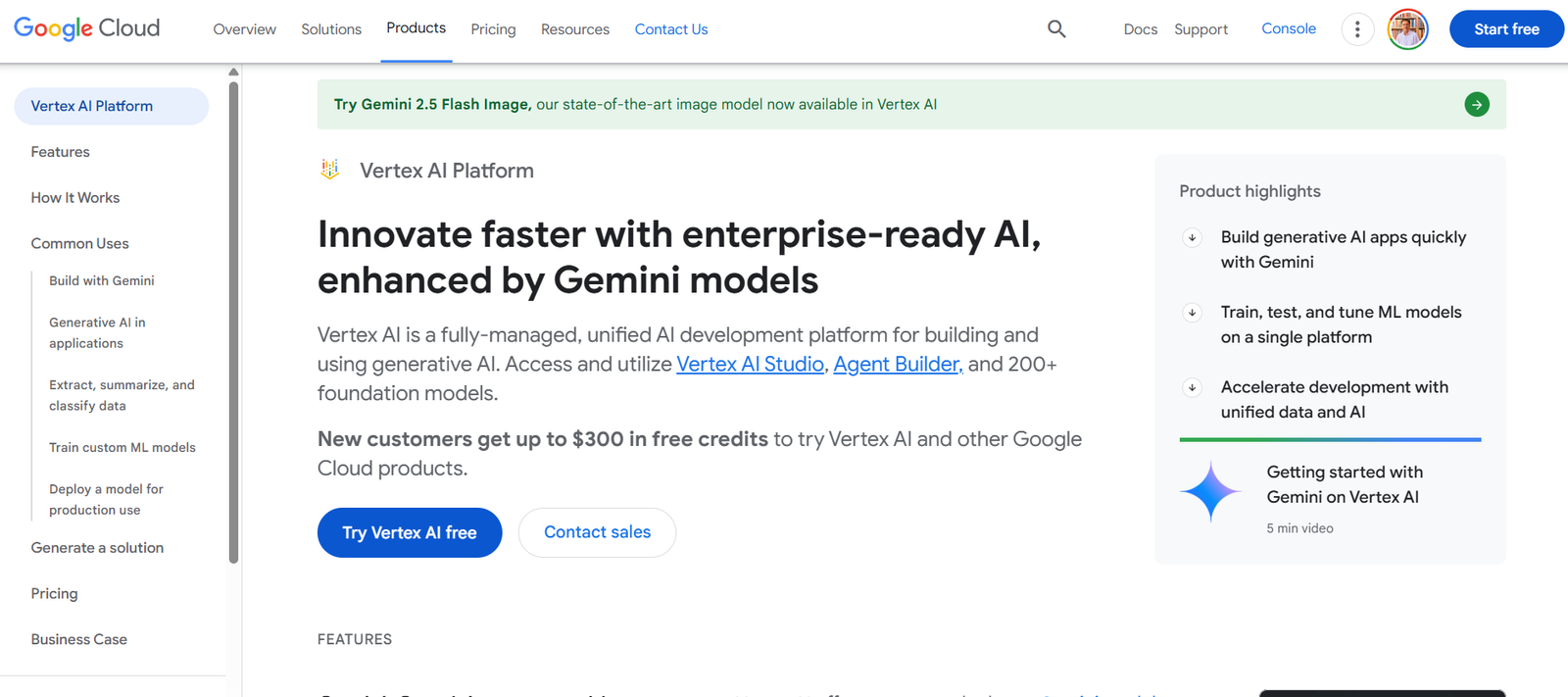
AI and Machine Learning Tools: Access pre-trained AI models (e.g., Vision AI, Natural Language AI, Translation AI) or build and train custom models using Vertex AI.
Big Data Analytics: BigQuery provides fast and scalable analytics over large datasets using SQL.
Networking: Global load balancing, virtual private cloud (VPC), and secure connectivity.
Security and Identity: Identity and Access Management (IAM), data encryption, compliance, and secure service deployment.
DevOps and Monitoring: Cloud Build, Artifact Registry, and operations suite for CI/CD and performance monitoring.
API Management: Apigee for building and managing APIs at scale.
How It Works
Google Cloud operates on a pay-as-you-go cloud model, where users only pay for the resources they use. The platform is accessed via:
Google Cloud Console: A web-based UI to manage resources, deploy applications, and monitor performance.
Cloud SDK and CLI: Command-line tools for developers to automate tasks and manage infrastructure programmatically.
APIs and Libraries: Developers can integrate services into their apps using client libraries available in multiple programming languages.
AI Platform (Vertex AI): For training, deploying, and managing machine learning models at scale.
To get started, users can sign up for an account, select the services they need, and deploy resources through the console or command-line interface. Google Cloud also offers extensive documentation and training resources for onboarding and development.
Use Cases
Google Cloud is highly versatile and serves a broad range of industries and use cases. Some of the most common include:
Application Hosting: Hosting scalable web and mobile apps using Compute Engine or App Engine.
AI and Machine Learning: Training and deploying custom AI models with Vertex AI or using pre-trained APIs for computer vision, natural language processing, and speech recognition.
Data Warehousing and Analytics: Running large-scale analytics using BigQuery to derive business insights.
eCommerce and Retail: Supporting personalized recommendations, inventory forecasting, and secure transactions.
Healthcare and Life Sciences: Enabling secure data storage, advanced imaging analysis, and predictive analytics.
Gaming: Providing backend infrastructure, real-time analytics, and global game server hosting.
Financial Services: Supporting risk analysis, fraud detection, and regulatory compliance.
Media and Entertainment: Facilitating content delivery, live video processing, and cloud rendering.
Pricing
Google Cloud uses a pay-as-you-go pricing model, which means customers are charged based on actual usage. Pricing is typically categorized by product or service.
Examples include:
Compute Engine: Starts at approximately $0.0104/hour for small instances.
Cloud Storage: Standard storage starts around $0.020 per GB per month.
BigQuery: Pricing is based on data processed ($5 per TB queried) or a flat-rate subscription.
Vertex AI: Custom model training starts at $0.49 per training hour, depending on the machine type.
Google Cloud offers:
Free Tier: Includes limited usage of products like Compute Engine, Cloud Storage, and BigQuery every month.
$300 Free Trial Credit: New users receive $300 in credit to explore the platform over 90 days.
For detailed and up-to-date pricing, visit the Google Cloud Pricing page.
Strengths
Google Cloud stands out for several reasons:
Industry-Leading AI and ML: Vertex AI, natural language APIs, and other AI tools are state-of-the-art.
High Reliability and Scalability: Built on Google’s global infrastructure.
Security and Compliance: Offers industry-standard security practices and compliance certifications.
Integrated Tools for Developers: Rich ecosystem of APIs, SDKs, and CI/CD tools.
Open Source Friendliness: Strong support for Kubernetes, TensorFlow, and other open-source technologies.
Global Network Infrastructure: High-speed, low-latency global connectivity.
Drawbacks
Despite its advantages, Google Cloud has some limitations:
Learning Curve: The platform can be complex for beginners, especially those unfamiliar with cloud infrastructure.
Pricing Complexity: The pay-as-you-go pricing structure can be confusing without careful monitoring.
Smaller Market Share: Compared to AWS and Azure, Google Cloud has a smaller enterprise customer base, which may affect ecosystem support in certain regions.
Limited Onboarding for SMEs: Small businesses may find the initial setup and customization overwhelming without technical support.
Comparison with Other Tools
Google Cloud is often compared with:
Amazon Web Services (AWS): The market leader in cloud services with a broader product offering but less focus on AI/ML simplicity.
Microsoft Azure: Strong in hybrid cloud and enterprise integration, particularly for companies already using Microsoft products.
IBM Cloud: Focused on enterprise and hybrid solutions with Watson AI but lacks the scale and global infrastructure of Google Cloud.
Where Google Cloud stands out is in AI/ML capabilities, developer experience, and data analytics performance with tools like BigQuery and Vertex AI.
Customer Reviews and Testimonials
Google Cloud receives consistently positive feedback from enterprises and developers across the globe.
Public reviews highlight the following:
Scalability and Speed: Users praise its ability to handle large workloads with minimal latency.
AI and Data Tools: Businesses in tech, healthcare, and retail appreciate the power and usability of Vertex AI and BigQuery.
Developer Experience: Rich documentation, sample projects, and SDKs make development efficient.
On platforms such as G2 and TrustRadius, Google Cloud typically holds ratings between 4.3 and 4.6 out of 5. Common praise includes reliability, ease of integration, and support quality. Some users note that the billing structure can be difficult to understand, and support is sometimes delayed for lower-tier customers.
Prominent companies using Google Cloud include:
Twitter
PayPal
Spotify
The Home Depot
Toyota
Target
Conclusion
Google Cloud is a robust, scalable, and forward-thinking platform that serves as a foundation for modern application development, big data analytics, and artificial intelligence. Its comprehensive suite of cloud services enables organizations of all sizes to build innovative solutions, improve efficiency, and scale globally.
With state-of-the-art tools for machine learning, a developer-friendly ecosystem, and a global infrastructure backbone, Google Cloud is ideal for companies seeking agility, speed, and technological leadership. Whether you’re a startup experimenting with AI or an enterprise undergoing digital transformation, Google Cloud offers the tools, performance, and flexibility needed to succeed.