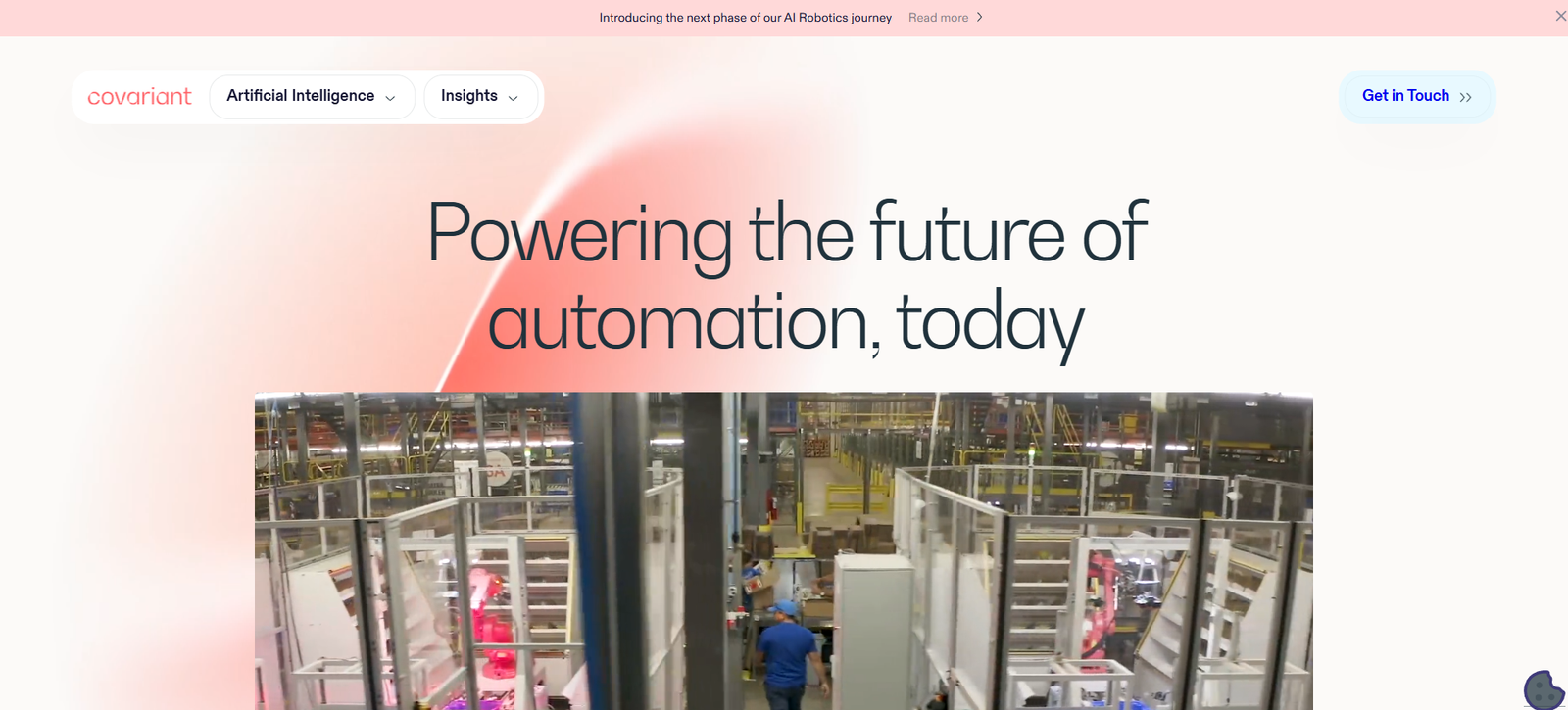
Covariant is a California-based AI robotics company that builds autonomous picking and sorting robots for warehouses. Unlike conventional robotic systems that rely on pre-programmed instructions, Covariant robots are powered by the Covariant Brain—a unified artificial intelligence platform that enables robots to learn from experience and perform complex manipulation tasks with human-level dexterity and adaptability.
Founded in 2017 by leading AI researchers from UC Berkeley, Covariant is backed by investors like Index Ventures, Radical Ventures, and Baillie Gifford. The company’s mission is to enable all robots to see, reason, and act autonomously in the real world.
Covariant’s technology is already in production across warehouses in North America, Europe, and Asia, enabling logistics providers, 3PLs, and retailers to meet fulfillment demand with greater speed and accuracy.
Features
Covariant delivers a powerful set of features through its AI robotics platform, built to adapt to the evolving needs of warehouses:
Covariant Brain (AI Control System)
The core software platform that powers all Covariant robots, enabling real-time perception, decision-making, and motion control. It uses deep reinforcement learning and neural networks trained across a global fleet of robots.Universal Item Handling
Capable of picking millions of SKU types—including deformable, transparent, or irregularly shaped items—without prior training data for each one.Vision-Based Perception
Advanced computer vision enables robots to identify, classify, and locate items in cluttered or mixed environments with high accuracy.Autonomous Picking and Sorting
Robots perform bin picking, putwall sorting, order consolidation, and returns processing tasks with minimal human supervision.Continuous Learning System
Robots learn from each pick, improving over time and sharing knowledge across the entire fleet, similar to autonomous vehicles.Cloud Connectivity and Analytics
Monitor robot performance, uptime, and throughput from a cloud-based dashboard. Real-time data helps operators track KPIs and optimize workflows.Flexible Hardware Integration
Works with leading industrial robot arms and custom end-of-arm tools, making Covariant robots adaptable to various warehouse configurations.
How It Works
Covariant’s robotic systems are designed to be plug-and-play with existing warehouse infrastructure, but the real magic happens under the hood—powered by AI. Here’s a step-by-step look at how it works:
Vision & Perception
The robot uses multiple cameras to perceive the environment and scan items in real time.AI Decision-Making
The Covariant Brain analyzes visual input, determines the best picking strategy, and plans the motion path to execute the action. It considers object shape, material, weight, and placement.Robotic Action
The robot arm picks or moves the item using a gripper customized for the task—such as suction, fingers, or hybrid tools.Learning & Feedback
If a pick attempt fails, the system logs the outcome and uses reinforcement learning to improve future actions. These learnings are shared across Covariant’s global network of robots.Human Oversight
Operators can monitor the system via the Covariant dashboard, intervene if needed, and access detailed analytics for performance tracking.
Use Cases
Covariant is built for high-volume, high-variability warehouse operations across multiple industries:
eCommerce Fulfillment Centers
Automate the picking of thousands of different SKUs to speed up order fulfillment and reduce labor bottlenecks.Third-Party Logistics (3PL)
Provide scalable, flexible automation to meet the demands of multiple client accounts with ever-changing inventories.Retail Distribution
Sort and consolidate items for store replenishment, especially in sectors like apparel, cosmetics, and electronics.Grocery and Perishables
Handle irregular items like produce, packaged foods, and household goods that vary in shape and size.Returns Processing
Automate the sorting and handling of returned items, which are often unstructured and require adaptive manipulation.
Pricing
Covariant does not list pricing on its official website. The company follows a custom pricing model based on:
Number of robot units required
Type of warehouse tasks (e.g., picking, sorting, returns)
Desired throughput or ROI goals
Integration complexity and system configuration
Covariant works directly with enterprise clients to scope, configure, and deploy tailored solutions. For pricing estimates or consultations, businesses are encouraged to request a demo via the Covariant contact page.
Pricing typically includes hardware, software licensing (Covariant Brain), integration services, and ongoing support.
Strengths
True AI-based robotics that improves autonomously over time
Handles high SKU variability without constant reprogramming
Proven in real-world warehouse deployments across industries
Reduces labor dependence and operational bottlenecks
Scalable and modular—can be deployed for one or many tasks
Enables faster ROI than traditional robotic systems due to AI adaptability
Drawbacks
Enterprise-level pricing; not suitable for small warehouses or startups
Requires professional integration and facility assessment
Limited to physical goods handling—does not address warehouse software or non-physical logistics
AI performance may vary depending on lighting, product mix, and bin layout (though improving rapidly)
Comparison with Other Tools
Covariant vs. Kindred Sort (Ocado Group)
Kindred uses reinforcement learning for order picking in apparel and general merchandise. Covariant offers broader SKU handling and deeper AI integration across multiple warehouse tasks.
Covariant vs. Berkshire Grey
Berkshire Grey provides full warehouse automation systems. Covariant focuses more on modular, intelligent picking robots that can be integrated into existing infrastructure.
Covariant vs. Locus Robotics
Locus is focused on AMRs (autonomous mobile robots) for order picking support, while Covariant specializes in robotic arms for complex manipulation tasks.
Covariant vs. RightHand Robotics
RightHand is a close competitor offering piece-picking robots. Covariant differentiates with a more advanced AI learning loop and broader manipulation capabilities.
Customer Reviews and Testimonials
While Covariant does not publicly list traditional customer testimonials on its homepage, it has been featured in top publications like TechCrunch, Forbes, and The Wall Street Journal for its groundbreaking work in AI robotics.
The company has confirmed successful partnerships with global retailers and 3PLs, reporting:
Up to 99% pick accuracy in live environments
Significant labor cost savings and higher throughput
Improved warehouse resilience during peak periods
Notably, Covariant has partnered with major brands such as Obeta and ABB to deploy robots across global facilities.
Conclusion
Covariant is at the forefront of warehouse automation, providing intelligent, AI-powered robots that pick and sort with human-level adaptability. Its combination of computer vision, machine learning, and real-world deployment makes it one of the most advanced solutions in modern logistics.
For enterprise fulfillment centers, 3PLs, and retailers looking to increase throughput, reduce labor costs, and future-proof their operations, Covariant delivers a powerful solution that continues to learn and improve with every task.