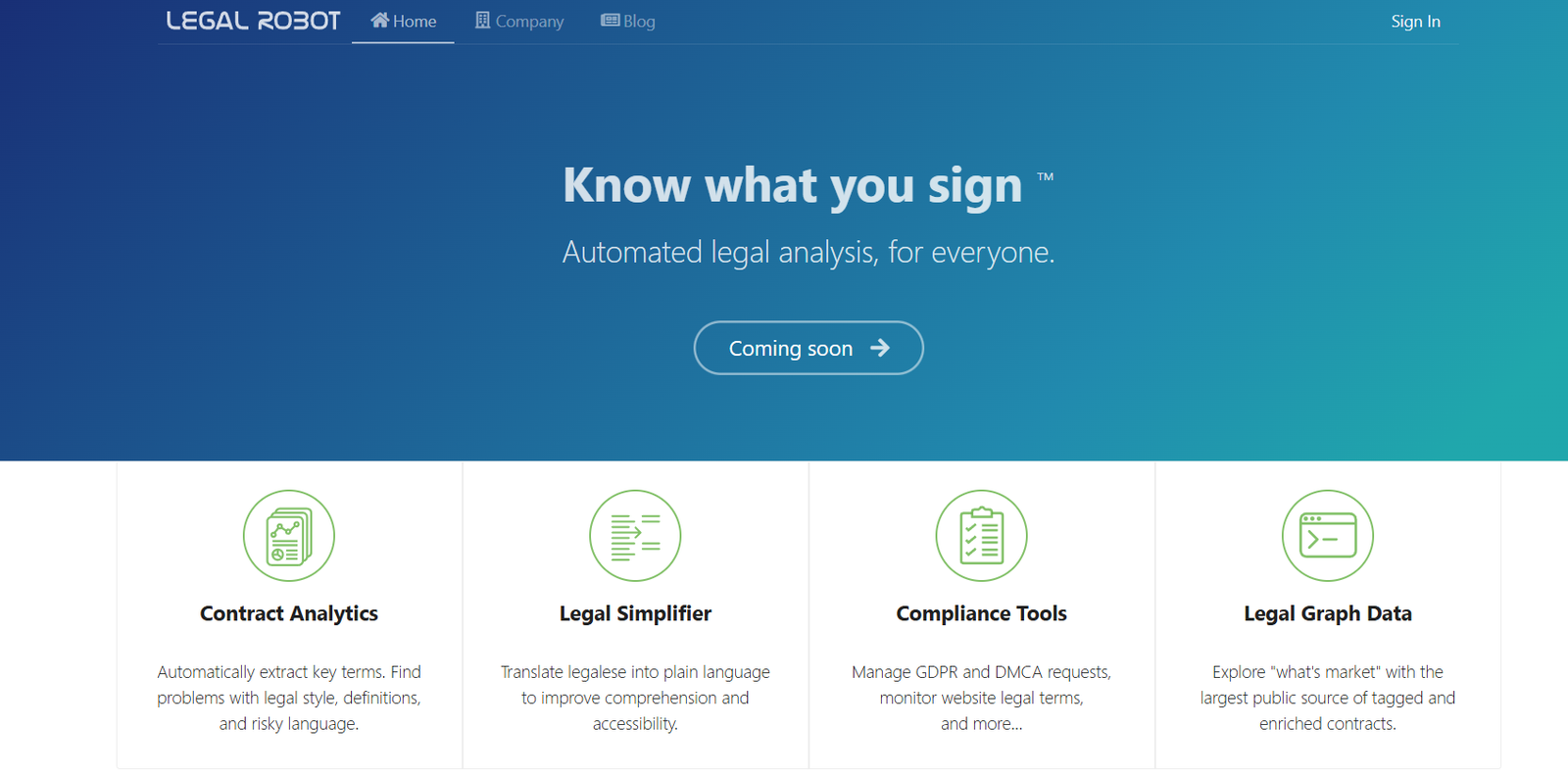
LegalRobot is an AI-powered legal tool designed to help users understand and analyze legal documents. By using advanced machine learning and natural language processing, LegalRobot simplifies complex legal language, identifies potential risks, and ensures that documents meet common legal standards. Its goal is to make legal documents more transparent, readable, and compliant—whether you’re a lawyer, a business professional, or an individual handling contracts.
LegalRobot was developed to address a key pain point in the legal industry: the difficulty of interpreting dense legal jargon and identifying compliance issues quickly. By automating legal analysis, it reduces the time and effort spent reviewing documents, making it easier to spot issues and make informed decisions.
Features
LegalRobot offers a robust suite of features focused on improving document clarity, legal compliance, and risk assessment.
Legal Language Analysis: Evaluates text to identify complex legal terms and provides plain-language translations.
Statistical Comparison: Compares your document’s language patterns with millions of other legal documents to detect anomalies.
Readability Assessment: Scores how readable your legal content is, helping you create documents that are easier to understand.
Legal Consistency Check: Reviews the consistency of terms, definitions, and references throughout the document.
Risk Identification: Flags potentially problematic clauses, such as one-sided terms or ambiguous obligations.
AI-Based Document Parsing: Breaks down sections and highlights key elements like jurisdiction, liability, and indemnification.
These features help reduce legal risk and ensure that contracts and agreements are written in a clear and compliant manner.
How It Works
LegalRobot uses artificial intelligence technologies, including deep learning and natural language processing, to parse and evaluate legal documents. Here’s a general breakdown of how it works:
The user uploads a contract or agreement in formats such as PDF or Word.
The platform then analyzes the document using trained AI models built on millions of legal documents.
The analysis engine detects patterns, terminology, and clause structures, benchmarking them against standard legal practices.
The tool highlights sections that are unusual or potentially problematic and provides plain-language explanations for complex legal jargon.
Users can interact with the tool to explore suggestions and generate reports that can be shared with legal teams or clients.
The goal is to give users actionable insights that enhance their understanding of legal content without needing to be a legal expert.
Use Cases
LegalRobot is useful in a variety of legal and business scenarios where contract comprehension and compliance are essential.
Small Businesses: Entrepreneurs and startups can use LegalRobot to understand standard agreements like NDAs, service agreements, and vendor contracts.
In-House Legal Teams: Legal departments can quickly screen large volumes of documents for compliance and readability before sending them for legal review.
Freelancers and Contractors: Independent professionals can verify that the contracts they’re asked to sign are fair and balanced.
HR Departments: Human resources teams can analyze employment contracts for clarity and compliance with company policies.
Compliance Officers: Ensure that contractual language aligns with legal and regulatory frameworks.
By addressing a wide range of contract types, LegalRobot is a flexible solution for professionals across industries.
Pricing
As of the latest information from the LegalRobot official website, the platform offers the following pricing structure:
Free Plan: Basic document analysis and access to readability reports. Limited features.
Pro Plan: Includes advanced legal analysis, risk detection, and deeper language comparison. Pricing is not publicly listed and may require direct contact for a quote.
Enterprise Plan: Custom solutions for large teams with additional compliance and integration features. Contact required for pricing.
The platform appears to operate on a freemium model, where users can try basic features at no cost and unlock advanced tools with a paid subscription.
Strengths
LegalRobot provides a number of advantages for both legal professionals and non-experts:
Simplifies Legal Language: Converts complex legal jargon into understandable terms.
Automates Risk Detection: Reduces manual review time by automatically flagging issues.
User-Friendly Interface: Easy-to-use dashboard that doesn’t require legal training.
Data-Driven Analysis: Benchmarks your contract against a large dataset of legal texts.
Time-Saving: Speeds up the document review process significantly.
These benefits make LegalRobot particularly attractive to startups, freelancers, and businesses with limited legal resources.
Drawbacks
While LegalRobot is a powerful tool, it does have some limitations:
Not a Substitute for Legal Advice: The platform is clear that it does not replace professional legal counsel.
Limited Customization: May not handle complex or industry-specific contracts as well as a specialized legal review.
Unclear Pricing: Some advanced plans lack transparent pricing information on the website.
English-Focused: Currently optimized for English legal documents, which may limit use in multilingual or international contexts.
These are important considerations for users who require deeper legal insight or deal with highly specialized documents.
Comparison with Other Tools
When compared with other legal tech tools like LawGeex, DoNotPay, or ContractPodAI, LegalRobot stands out for its focus on readability and language analysis rather than document automation or legal task execution.
LawGeex focuses on automating legal workflows and contract approvals for enterprises.
DoNotPay is a consumer-focused AI legal assistant for handling everyday legal issues like parking tickets and refunds.
ContractPodAI offers full contract lifecycle management for large organizations.
LegalRobot, by contrast, is better suited for individuals and small businesses that need to understand what they’re signing and avoid hidden risks without employing full-scale legal automation platforms.
Customer Reviews and Testimonials
LegalRobot has been featured on platforms like Product Hunt, where users highlight its usefulness in translating complex legal documents into everyday language. Common praise includes:
Easy to understand interface
Useful for freelancers and startups
Accurate plain-language interpretations
While formal enterprise case studies are limited, general sentiment reflects satisfaction among users who need quick, AI-assisted contract analysis. Users also appreciate the free tier for trying out basic features.
Conclusion
LegalRobot is an effective AI legal assistant for anyone who deals with contracts and legal agreements but lacks the resources or expertise to analyze them thoroughly. Its strengths lie in simplifying legal language, detecting risk, and offering comparative insights without overwhelming the user.
While it should not be viewed as a replacement for professional legal services, it serves as a powerful first layer of defense in understanding and improving legal documentation. Particularly for startups, small businesses, and freelancers, LegalRobot provides a practical and accessible legal analysis solution.
For those seeking to make smarter decisions about the agreements they enter into, LegalRobot offers a trustworthy starting point.