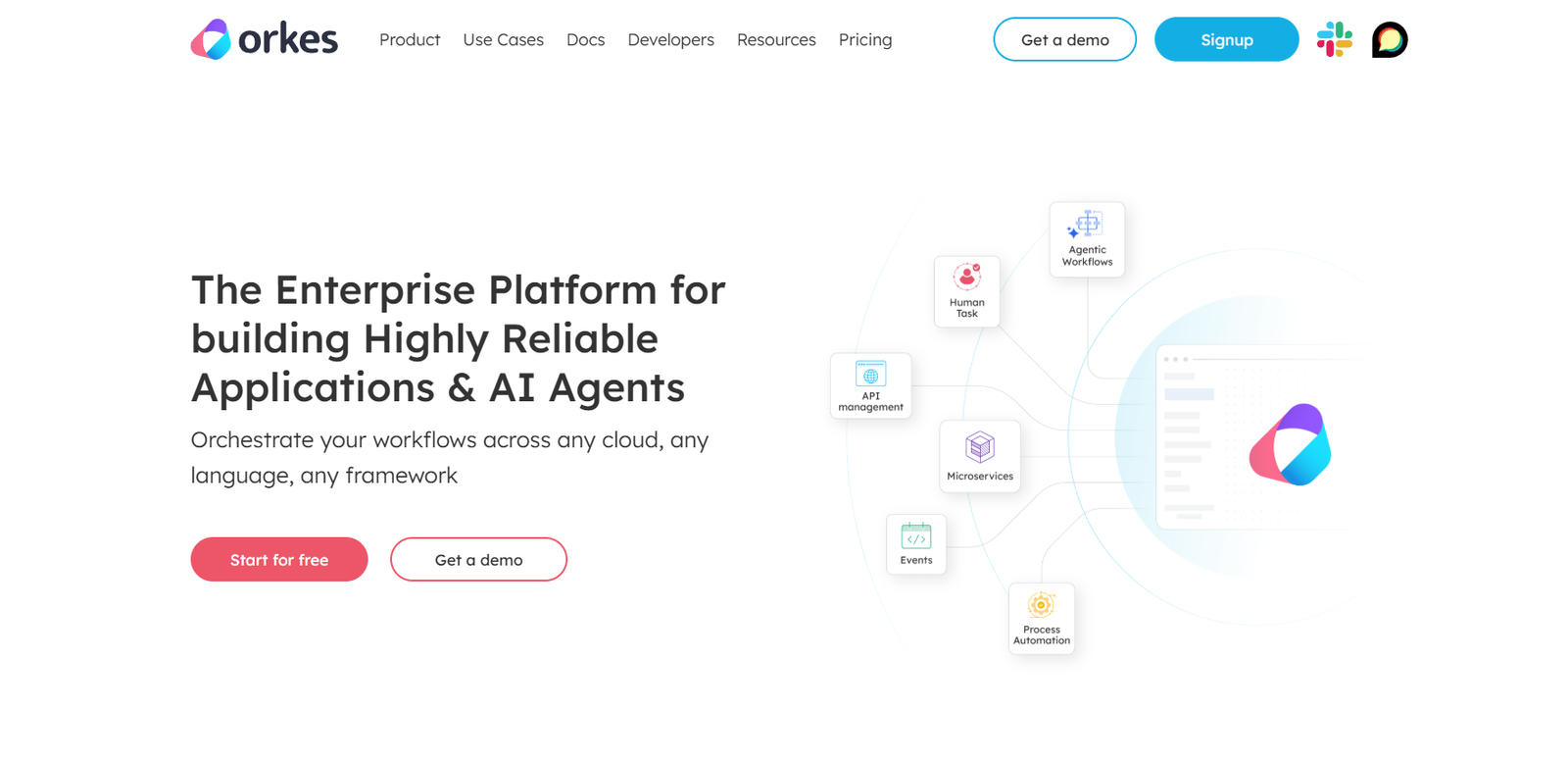
Orkes is a modern, cloud-native platform designed to simplify workflow orchestration for microservices and complex distributed systems. Built on the open-source Netflix Conductor, Orkes brings enterprise-ready enhancements like security, scalability, observability, and managed infrastructure—helping teams automate and scale mission-critical business processes.
Designed for developers and engineering teams, Orkes enables you to model and execute dynamic workflows that span multiple services, APIs, and systems. With powerful tooling, low-latency execution, and built-in reliability features, Orkes supports use cases in finance, e-commerce, SaaS, logistics, and more.
Features
Orkes extends Netflix Conductor with robust, enterprise-level capabilities:
Visual Workflow Designer
Drag-and-drop interface to build and test workflows, enabling faster prototyping and easier collaboration across teams.Cloud-Native Architecture
Deploy workflows on the cloud (Orkes Cloud), hybrid, or on-premise infrastructure with autoscaling and high availability.Task Workers and SDKs
Support for Java, Python, Go, and other SDKs for building custom task workers that plug into workflows.Advanced Workflow Management
Support for dynamic forks, joins, retries, timeouts, conditional flows, and sub-workflows.Authentication and Access Control
Enterprise-grade security including SSO, RBAC, OAuth2, and multi-tenant support.Monitoring and Observability
Built-in dashboards, real-time metrics, logging, and tracing to ensure visibility across the entire execution lifecycle.Audit and Compliance
Full history tracking, execution logs, and audit trails to support governance and accountability.Resilience and Fault Tolerance
Automatic retries, circuit breakers, and failover mechanisms for mission-critical applications.Versioning and Rollbacks
Maintain different workflow versions and roll back or test changes without impacting production.
How It Works
Orkes functions as a workflow orchestration layer that enables microservices and APIs to interact within structured, observable processes:
Define Workflows
Use the visual builder or JSON/YAML specifications to define workflows with tasks, conditions, and data flow.Register Task Workers
Write task implementations in your preferred language using Orkes SDKs. These workers execute tasks when triggered by workflows.Execute Workflows via APIs
Launch workflows programmatically through REST or gRPC APIs or in response to business events.Monitor and Troubleshoot
Track execution in real time, view failures, and monitor performance through the Orkes UI and metrics dashboards.Scale and Secure
Orkes handles horizontal scaling, fault recovery, and secure multi-team operations in a production-ready environment.
This approach supports event-driven architectures, microservices orchestration, and backend automation without introducing monoliths.
Use Cases
Orkes is ideal for organizations managing complex or high-volume systems:
Microservices Orchestration
Coordinate and manage services in distributed architectures with reliability and transparency.Order and Payment Processing
Automate multistep business flows involving billing, inventory checks, and shipping logic.KYC and Onboarding Workflows
Streamline document collection, identity verification, and approvals using automated sequences.Incident Management and Alerting
Orchestrate escalation, logging, and resolution steps in DevOps and SRE environments.SaaS Multi-Tenant Workflows
Deploy workflows with tenant-aware logic and security controls.Compliance and Reporting Pipelines
Automate audit logging, report generation, and submission flows under compliance mandates.ML and Data Pipelines
Chain together data preprocessing, model training, and deployment steps with error handling and observability.
Pricing
As of June 2025, Orkes offers tiered pricing based on deployment method and usage requirements. Full pricing is available upon request, but general offerings include:
Free Plan (Orkes Cloud)
Limited workflows and executions per month
Access to visual builder and SDKs
Ideal for prototyping and individual developers
Growth and Business Plans (Contact for Pricing)
Increased workflow limits
Advanced security and team collaboration
SLA-backed support
API rate scaling and uptime guarantees
Enterprise Plan
Custom SLAs
On-premise or hybrid deployment
Single-tenant architecture
Dedicated support and professional services
SOC 2, HIPAA, and compliance support
Visit https://orkes.io to request a demo or pricing quote.
Strengths
Orkes brings several unique advantages for engineering and DevOps teams:
Production-Grade Orchestration
Enterprise-ready platform built on the battle-tested Netflix Conductor framework.Rapid Development Cycle
Visual designer and SDKs speed up workflow development without sacrificing control.Scalability and Resilience
Handles thousands of concurrent workflows with built-in retries, monitoring, and failover.Secure and Compliant
Multi-layered access control and regulatory readiness support secure enterprise use.Developer Friendly
Robust documentation, APIs, and GitHub examples make it easy to onboard engineering teams.Modular and Extensible
Plug into existing systems using task workers, event queues, or external APIs.
Drawbacks
Despite its strengths, Orkes may present challenges for some teams:
Learning Curve
Teams unfamiliar with workflow orchestration or microservices may need time to understand task design and event flows.Developer-Centric
Requires technical knowledge to implement task workers and manage workflows effectively.No Built-In Business Logic UI
While powerful, Orkes focuses on execution and not on building front-end interfaces or dashboards for end-users.Pricing Transparency
Enterprise pricing is not publicly listed, which may make initial evaluation harder for small teams.
Comparison with Other Tools
Orkes vs. Temporal
Temporal is also a developer-first orchestration platform. Orkes offers stronger visual tooling and Netflix Conductor compatibility, while Temporal emphasizes code-native workflows.
Orkes vs. Apache Airflow
Airflow is designed for data pipelines, not event-driven systems. Orkes excels in real-time microservices orchestration with broader use cases.
Orkes vs. Camunda
Camunda offers BPMN-based orchestration, often used by business users. Orkes provides developer-first orchestration with API-driven flexibility.
Orkes vs. AWS Step Functions
AWS Step Functions are limited to the AWS ecosystem. Orkes is cloud-agnostic and highly customizable across environments.
Customer Reviews and Testimonials
While public review aggregators are limited due to Orkes’ enterprise focus, customer case studies on their website highlight:
“We migrated from in-house scripts to Orkes and reduced workflow errors by 70%.”
“Orkes gives us a clear view into every workflow. Debugging and compliance became a breeze.”
“It’s like Kubernetes for workflows—powerful, scalable, and reliable.”
Engineering teams value Orkes for its performance, visibility, and the ability to operate at scale without bottlenecks.
Conclusion
Orkes is a robust, developer-friendly platform that empowers organizations to orchestrate complex workflows across microservices, APIs, and data systems. With Netflix Conductor at its core and enhanced by enterprise-grade features, Orkes is purpose-built for teams that need performance, reliability, and full observability.
Whether you’re building financial services, onboarding pipelines, or large-scale SaaS automation, Orkes delivers the flexibility and control required for modern application orchestration.