
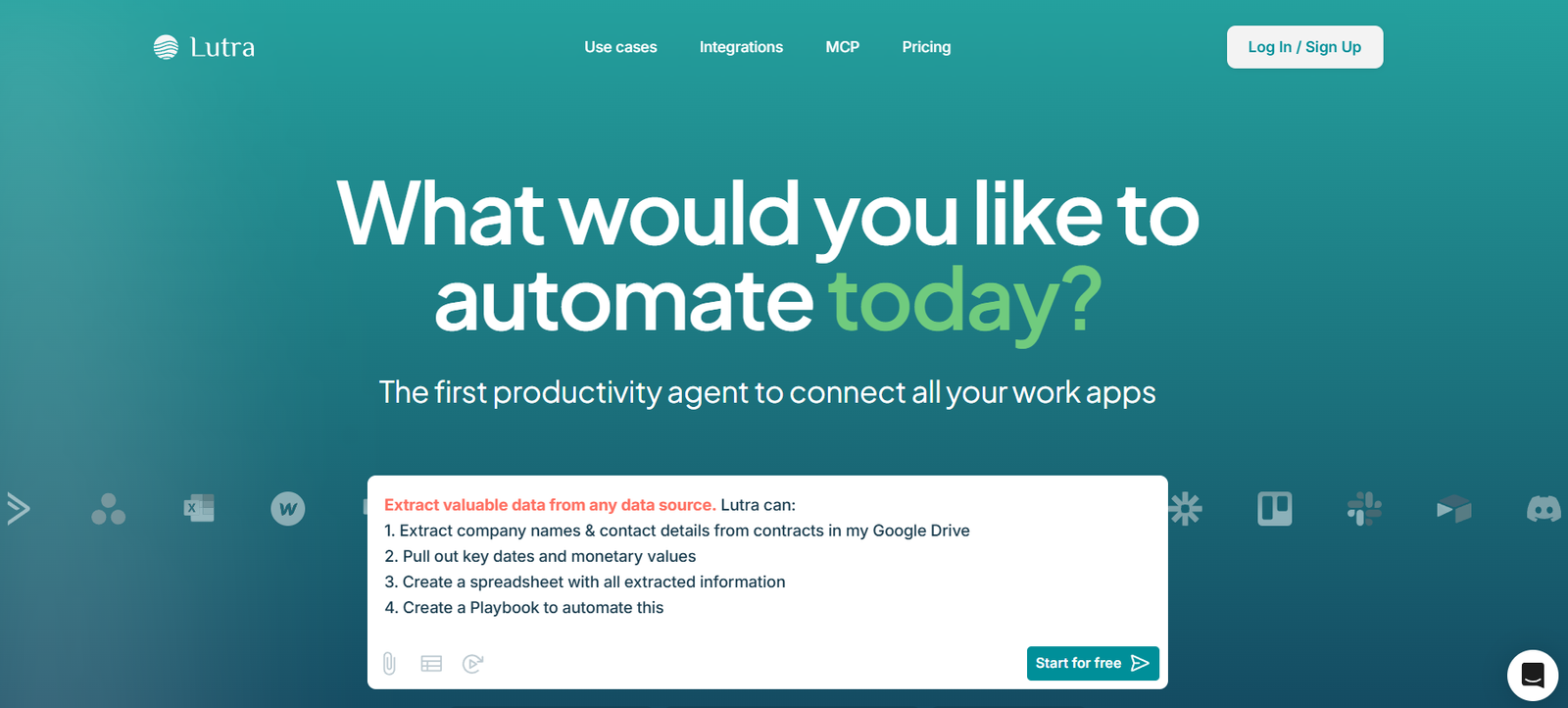
Lutra AI is a cutting-edge platform that leverages autonomous AI agents to streamline, automate, and optimize complex enterprise workflows—especially those involving data querying, analysis, and reporting. Built for modern enterprises, Lutra bridges the gap between siloed systems and operational intelligence by enabling AI to autonomously retrieve data, make decisions, and act on business logic across tools like CRMs, databases, spreadsheets, and cloud platforms.
Lutra’s core innovation lies in its fully autonomous AI worker model. Unlike typical AI assistants that require human prompting, Lutra agents can understand business goals, plan multi-step tasks, execute them across systems, and learn over time. This makes it ideal for teams seeking to reduce manual work in analytics, operations, and reporting while ensuring security and compliance.
Features of Lutra AI
Autonomous AI Agents
Lutra’s agents function like virtual employees. Once given access to your tools and workflows, they can proactively complete tasks—without needing step-by-step instructions.
Multi-System Integration
Out-of-the-box support for popular enterprise systems like Salesforce, Notion, HubSpot, Airtable, Google Sheets, Slack, databases, and more.
Natural Language Task Execution
You can describe goals in plain English, such as “generate weekly sales report” or “update customer data,” and Lutra will plan and execute the workflow.
Task Planning and Chain Execution
Agents can break down complex goals into sequences, choose the right APIs or data queries, and handle dependencies automatically.
Real-Time Data Access
Lutra AI connects live to your data sources, ensuring the output is always fresh and accurate—ideal for financial reports, customer dashboards, or KPI updates.
Secure Credential Vaulting
Uses secure authentication and token management to connect to your systems while preserving privacy and enterprise-grade security standards.
Autonomous Monitoring
Agents can be configured to watch for changes or triggers—like updates to CRM fields or incoming support tickets—and act accordingly.
Auditability and Logging
Every action taken by Lutra agents is logged for review, ensuring transparency and traceability—critical for enterprise compliance.
How Lutra AI Works
Connect Your Tools
Users securely connect data sources, business apps, and cloud tools to Lutra using built-in integrations or APIs.Describe a Goal in Natural Language
Enter a task such as “Prepare this month’s marketing performance summary using HubSpot and Google Sheets.”Lutra Plans and Executes
The AI agent analyzes the request, identifies necessary tools and data, builds a task plan, and begins execution—fetching data, updating files, sending messages, etc.Feedback and Monitoring
The system provides logs, results, and error reporting. You can give feedback to improve agent behavior or automate recurring tasks entirely.Learn and Reuse
Lutra AI agents improve over time based on usage patterns and feedback, becoming smarter and faster with each cycle.
Use Cases for Lutra AI
Sales and Revenue Ops
Automate creation of weekly or monthly sales dashboards by pulling data from Salesforce, HubSpot, and spreadsheets.
Marketing Performance Reporting
Track campaign metrics by querying data from platforms like Google Analytics or Airtable and compiling reports autonomously.
Customer Success Updates
Lutra can extract customer feedback, usage stats, and NPS scores across tools and generate summaries for CS teams.
Recruiting and HR Ops
Use Lutra to coordinate interview schedules, update candidate pipelines, and sync data between ATS tools and spreadsheets.
Finance and Forecasting
Pull data from ERP and accounting platforms to create automated cash flow or forecast reports.
IT Operations and Incident Monitoring
Agents can monitor ticketing systems, extract key metrics, and alert teams in Slack when thresholds are crossed.
Project Management Synchronization
Sync tasks across Notion, Asana, and Google Sheets; update project status and notify stakeholders on progress.
Pricing of Lutra AI
As of June 2025, Lutra AI has not publicly disclosed detailed pricing tiers. However, based on the platform’s enterprise-focused model, pricing is expected to be usage-based and tailored to organization size, with considerations including:
Number of agents deployed
Connected data sources and applications
Volume of tasks and data queries processed
Frequency of task automation (daily, hourly, event-based)
Support level and enterprise security requirements
Interested organizations can request access or a custom quote through Lutra’s official website: https://lutra.ai
Strengths of Lutra AI
Fully autonomous AI agents reduce human involvement in repetitive workflows
Easy natural language interface for non-technical users
Wide integration support for modern SaaS platforms and databases
Real-time, cross-system data orchestration
Strong focus on enterprise security and auditability
Learning agents that improve task performance over time
Transparent logs and monitoring for compliance and oversight
Drawbacks of Lutra AI
Currently in early access or limited release—may not be fully open to all users
Limited public documentation or community presence as of now
May require onboarding or configuration support for complex workflows
Enterprise-only focus; less accessible to solo professionals or small teams
AI behavior tuning may need feedback loops to align with specific business nuances
Comparison with Other Tools
Lutra AI vs. Zapier
Zapier is trigger-based and rule-driven. Lutra AI offers goal-based autonomous planning and execution—functioning like an intelligent teammate, not just a connector.
Lutra AI vs. LangChain Agents
LangChain allows developers to build agentic workflows using Python. Lutra provides a fully managed, no-code AI agent layer, built for end-users in business teams.
Lutra AI vs. Slackbots or GPT-4 Assistants
Standard AI assistants require prompts. Lutra agents autonomously operate based on goals, integrating deeply into enterprise systems to execute tasks.
Lutra AI vs. UiPath or Automation Anywhere
While RPA tools automate GUI and repetitive office tasks, Lutra focuses on API-level and SaaS automation, ideal for modern cloud-native workflows.
Customer Reviews and Testimonials
Because Lutra is in early access, few public reviews are available. However, early users and partners have shared encouraging feedback:
“We automated our end-of-week ops reporting using Lutra, saving 8+ hours of manual work weekly.” – Head of Revenue Ops, SaaS Startup
“It’s like having a junior analyst on our team that never sleeps.” – COO, Growth-Stage Fintech Firm
“Lutra AI pulled together data from five platforms to build investor updates we used in our board meetings.” – Founder, Seed-Stage Company
Lutra has been featured in early-stage innovation newsletters and is gaining traction among AI-forward enterprise teams.
Conclusion
In the age of intelligent automation, Lutra AI stands out by offering fully autonomous AI agents that go far beyond scripted workflows. From sales dashboards to marketing reports and project synchronization, Lutra enables teams to focus on outcomes while AI handles the process.
For organizations looking to scale operational efficiency, eliminate busywork, and create smarter workflows, Lutra AI provides the building blocks for an AI-augmented workforce—secure, scalable, and truly autonomous.


